
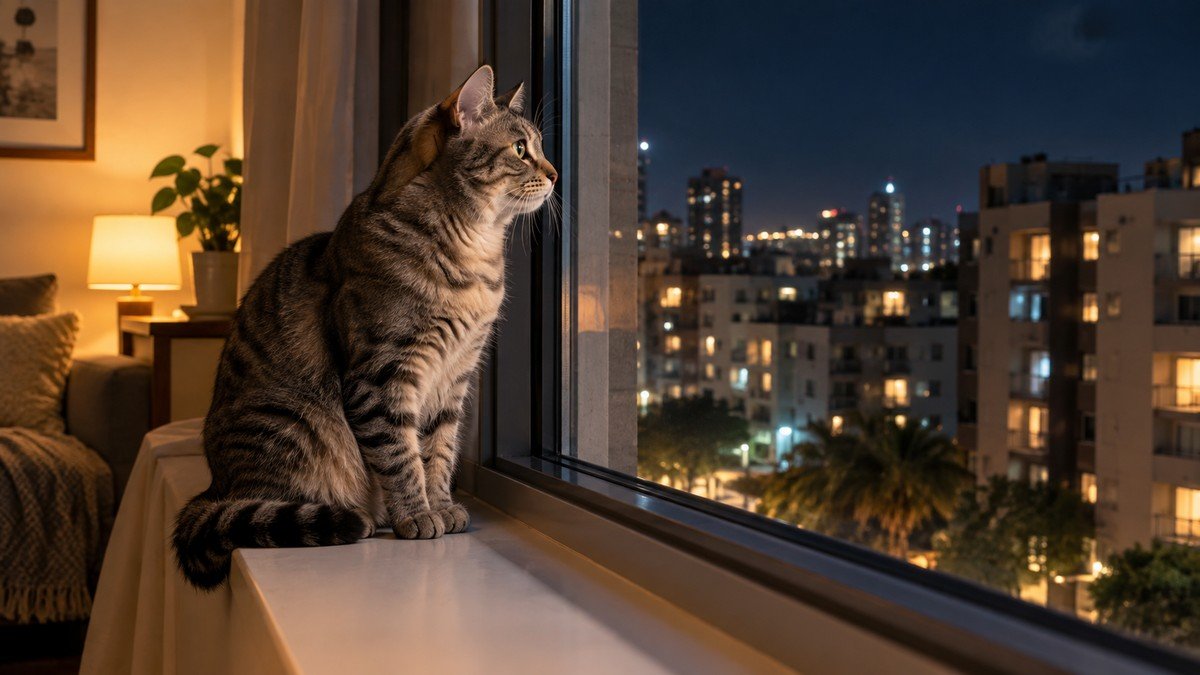
If you’ve been jolted awake at 2 a.m. by a cat yowling from the hallway, or you’ve gotten the dreaded knock (or noise-app notification) from a neighbor on the other side of a shared wall, you already know this isn’t just an annoying quirk. In a house with a yard and some distance from the next family, a vocal cat is a private problem. In an apartment, it’s a shared one — and it can turn into a lease issue faster than most people expect.
The good news: excessive nighttime meowing and yowling almost always has an identifiable cause, and most of the fixes don’t involve anything more complicated than a vet visit and a change to your evening routine. Here’s what veterinary and animal-behavior organizations actually say is going on, and what to do about it.
Start With a Vet Visit, Not a Behavior Plan
It’s tempting to jump straight to “how do I train this out of her,” but every source on this topic agrees the first step is ruling out a medical cause — especially if the vocalizing is new, sudden, or your cat is getting older.
The ASPCA notes that in aging cats, an overactive thyroid and kidney disease can both cause excessive vocalization, and that a range of underlying illnesses can leave a cat feeling “unusually hungry, thirsty, restless or irritable” — all of which can show up as crying, especially once the house goes quiet at night. Elderly cats experiencing cognitive decline may also meow simply because they’ve become disoriented.
VCA Animal Hospitals is direct about this: a “veterinary examination is recommended to rule out potential medical causes of vocalization such as pain, endocrine dysfunction and hypertension” before you assume it’s purely behavioral. The Animal Humane Society adds a useful rule of thumb — if a cat who was previously quiet suddenly starts vocalizing a lot, that change itself is worth a vet visit, not just the volume of noise.
If your cat is a senior and the vet has ruled out or treated any physical illness, ask specifically about cognitive dysfunction (the feline version of age-related confusion). It’s a documented, separate cause of nighttime crying that isn’t fixed by the daytime-routine changes below — it’s managed differently, sometimes with medication or environmental adjustments your vet can walk you through.
The Behavioral Causes, Once Medical Issues Are Ruled Out
Assuming your cat gets a clean bill of health, the remaining causes fall into a fairly short, well-documented list:
Attention-seeking. Cats that are home alone for long stretches — common in a one-person or two-working-adult apartment — can learn that meowing gets a reaction, even if the reaction is you getting up to shush them. The ASPCA points out that this is a self-reinforcing cycle: once a cat learns crying works, it keeps working. VCA’s guidance is blunt about the fix: “under no situation should the owner go to the cat if it vocalizes” once you’ve confirmed it’s not a genuine need — going to a crying cat, even to scold it, teaches the cat that crying gets your attention.
Hunger and feeding schedule. A cat used to being fed the moment you wake up has every incentive to wake you up early, and that habit often creeps earlier and earlier. The ASPCA’s specific recommendation is to stop feeding a cat “when she cries” and shift to a scheduled or automatic feeding routine instead, so the connection between crying and food gets broken.
Boredom and under-stimulation. Indoor cats without much daytime activity — especially younger cats — often save their energy for the quiet hours when the apartment is calm and the humans are trying to sleep. The Animal Humane Society and VCA both point to enrichment as the fix, not punishment: more interactive play, food-dispensing toys, and activity earlier in the evening so the cat is tired rather than wound up at bedtime.
Wanting in or out of a room. If your cat is shut out of the bedroom, or shut into one, crying at the door is a completely rational response. The ASPCA suggests a cat door or a consistent access arrangement rather than an inconsistent one, since cats notice when crying occasionally works.
Intact cats and mating behavior. If your cat isn’t spayed or neutered, heat cycles are a real and specific driver of yowling. The ASPCA notes a female’s heat cycle “lasts four to ten days” and can repeat every “18 to 24 days” during breeding season, and that intact males will vocalize in response to females in heat nearby. Spaying or neutering resolves this cause directly — it isn’t a training problem.
Breed tendencies. Some cats are just naturally more vocal. The ASPCA specifically calls out Siamese cats as a breed prone to frequent meowing and yowling — worth knowing so you’re not troubleshooting a “problem” that’s closer to a personality trait.
Fixing the Routine, Not Just the Noise
Once your vet has ruled out or addressed a medical cause, the fix for most behavioral nighttime vocalization is the same basic idea from every source: move your cat’s activity, attention, and food earlier in the day so nighttime is genuinely restful instead of the one block of time your cat has been saving up for.
VCA’s guidance frames this as rescheduling — giving the cat “food, play, affection and attention” during the day and evening specifically so there’s less unmet need left over for 2 a.m. In practice, that usually means:
- A play session in the early evening, ideally one that ends with the cat visibly tired rather than still keyed up
- A final, larger meal or scheduled feeding shortly before your own bedtime, rather than immediately after you wake up
- Real interaction — not just presence — during hours when you’re both awake, so quiet nighttime isn’t the only time your cat gets attention
- Consistency, since an intermittent response to crying (ignoring it most nights, giving in occasionally) is harder to unlearn than a rule you hold every time
If nighttime crying continues after a few weeks of a consistent routine change, VCA’s guidance suggests confining the cat to a separate room with everything it needs (litter box, water, a comfortable bed) overnight, specifically so the crying isn’t rewarded with entry to your room — a step to try before assuming the behavior is unfixable.
What Not to Do
Both the ASPCA and VCA are specific about this: don’t respond to demand-crying by giving the cat what it’s asking for, and don’t punish it either. The ASPCA warns against ever hitting or scolding a cat for vocalizing, since fear doesn’t produce lasting behavior change and can create new anxiety-driven problems. The Animal Humane Society makes the same point about attention generally — “attention, even negative attention, can reinforce the behavior” — so yelling at a crying cat can backfire by teaching it that noise equals a guaranteed reaction, good or bad.
The one exception worth remembering: don’t blanket-ignore all nighttime meowing without checking first. A cat that suddenly starts crying at the litter box, or seems distressed rather than demanding, may be telling you something real. If litter box access is a possible factor — especially in a studio or one-bedroom where a box might be tucked somewhere inconvenient overnight — our guide on how many litter boxes you actually need and where to put them covers placement that avoids exactly this kind of overnight access problem.
If a Neighbor Has Already Complained
In an apartment, cat yowling carries a risk dog barking doesn’t always share: it’s less predictable and harder to train on command, but landlords and neighbors generally hold pets to the same noise standard regardless of species. If you’ve already had a conversation with a neighbor or received a notice from your landlord, the lease-violation and noise-complaint process works the same way it does for barking — verbal warning, written notice, and escalation if it isn’t resolved. Our guide on dog barking and apartment noise complaints walks through that process in detail, including what a lease violation notice typically looks like and how to respond to one; the legal and lease mechanics there apply just as much to a vocal cat as to a barking dog.
FAQ
My cat only yowls at night, never during the day. Does that rule out a medical cause?
No. Senior cats with cognitive decline or sensory loss often vocalize specifically at night, when the house is dark and quiet and disorientation is more likely. A daytime-only “he seems fine” observation doesn’t rule out an age-related cause — mention the nighttime pattern specifically to your vet.
Will spaying or neutering stop all nighttime yowling?
It will resolve yowling that’s tied to heat cycles and mating behavior in an intact cat, but it won’t address attention-seeking, hunger-driven crying, boredom, or a medical issue. If your cat is already spayed or neutered and still vocalizing heavily, look at the other causes above.
Is it okay to use a spray bottle or loud noise to stop the crying?
Both the ASPCA and VCA’s guidance point away from punishment-based responses. A startle response might interrupt the behavior in the moment, but it doesn’t address why the cat is crying, and it can add anxiety on top of whatever’s already driving the behavior. Enrichment and a consistent routine are the recommended approach instead.
How long does it take for a routine change to work?
None of our sources give a specific timeline, and it will vary by cat and by how long the current pattern has been reinforced. Consistency matters more than speed — an occasional lapse (giving in “just this once”) tends to undo more progress than a slow week of steady effort.
Related safety guide: cat window and balcony safety in an apartment.
A Note From PawSpace Living
This article reflects veterinary and animal-behavior guidance from the ASPCA, the Animal Humane Society, and VCA Animal Hospitals. It isn’t a substitute for an actual veterinary exam, especially for a cat whose vocalizing is new, sudden, or paired with any other change in behavior, appetite, or litter box habits. Individual cats vary, and a persistent nighttime problem is worth a real conversation with your vet rather than trial-and-error alone.