
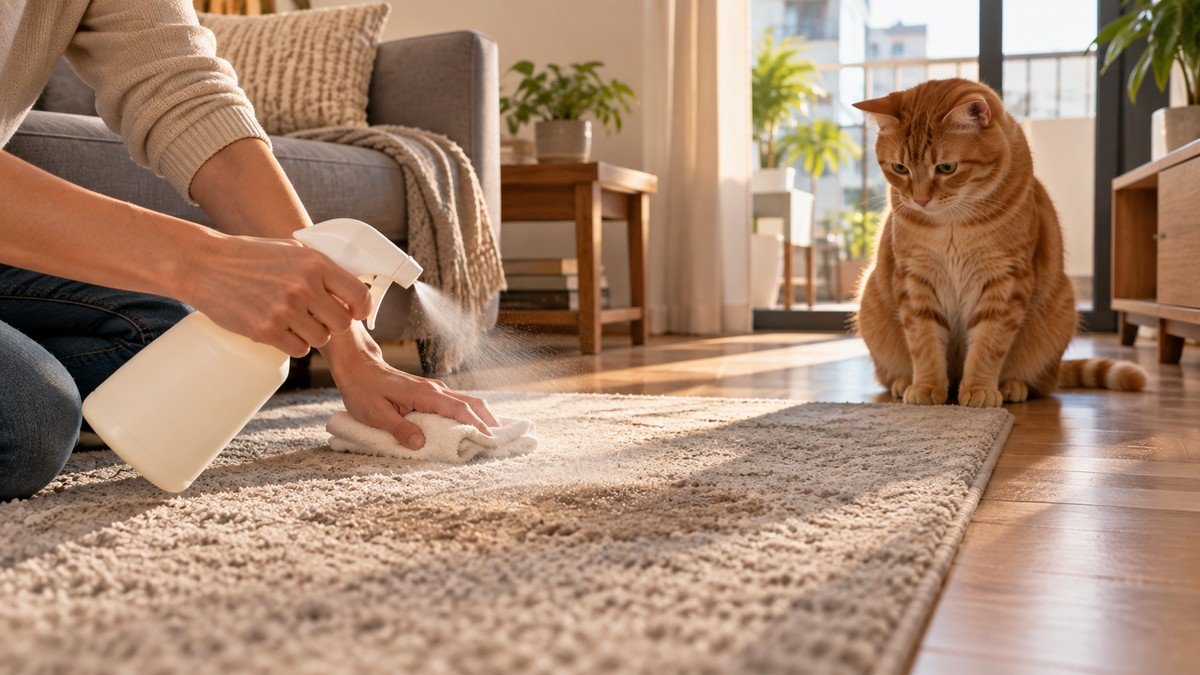
Pet urine is one of those problems that looks fixed and then isn’t. You blot it up, run a carpet cleaner over it, maybe scrub with dish soap, and the stain disappears. Then a warm, humid day rolls around, or the cat walks past that spot again, and the smell is back — sometimes worse than before. That’s not bad luck. It’s chemistry, and it’s the reason “enzymatic cleaner” shows up on nearly every credible source’s list of what to actually use.
This guide covers how enzymatic cleaners work, what the ASPCA specifically says to avoid, and how three widely available enzymatic cleaners compare on paper — without inventing lab results or claiming any of them was tested for this article.
Affiliate disclosure: As an Amazon Associate I earn from qualifying purchases. Read our full Affiliate Disclosure. We have not tested these products; see the comparison table below for manufacturer-stated details.
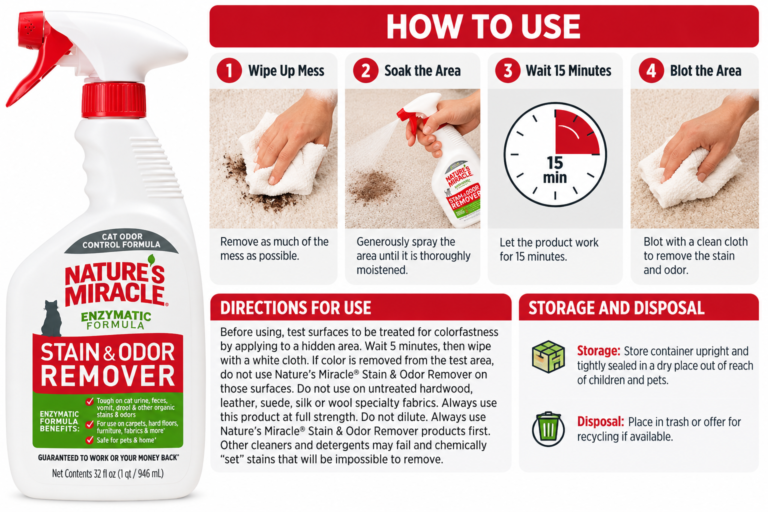
AI-generated illustration, not the actual product or packaging.
Product pick
Nature’s Miracle Stain & Odor Remover
Enzyme-producing formula activated by organic contact. Manufacturer-stated contact time: about 15 minutes; drying time: 24 hours.
Product pick
Rocco & Roxie Stain & Odor Eliminator
Enzymatic bacteria that feed on ammonia crystals and organic matter. Manufacturer-stated contact time: 30–60 minutes for new stains; air dry.
Product pick
Simple Solution Pet Stain & Odor Remover
Enzyme plus non-pathogenic bacteria ("3-in-1"). Manufacturer-stated contact time: 10+ minutes; drying time: 24–48 hours.
How Three Enzymatic Cleaners Compare (Manufacturer Specs Only)
No independent testing was done for this article. The information below comes directly from each brand’s own product pages, current as of research for this piece.
Product names in the table link to Amazon listings so you can check current sizes and availability. As an Amazon Associate I earn from qualifying purchases. See our affiliate disclosure. We have not tested these products, and Amazon listing titles can differ slightly from the manufacturer pages used for the specs above.
| Product | Formula type | Manufacturer-stated safe surfaces | Contact/wait time | Drying time |
|---|---|---|---|---|
| Nature’s Miracle Stain & Odor Remover | Enzyme-producing formula activated by organic contact | Carpets, hard floors, furniture, fabrics (not untreated hardwood, leather, suede, silk) | ~15 minutes | 24 hours |
| Rocco & Roxie Stain & Odor Eliminator | Enzymatic bacteria feeding on ammonia crystals/organic matter | Carpet, rugs, upholstery, tile/grout, wood (sparingly), leather, concrete, silk/wool (spot-test first) | 30–60 minutes (new stains); 1+ hour (set-in odor) | Air dry; vacuum once dry for deep-odor method |
| Simple Solution Pet Stain & Odor Remover | Enzyme + non-pathogenic bacteria (“3-in-1”) | Carpet, upholstery, bedding, fabric toys, clothing, other water-safe surfaces (not wool or leather) | 10+ minutes | 24–48 hours |
A few things worth noting rather than glossing over: Rocco & Roxie’s page lists more hard-surface and delicate-fabric uses than the other two, but also tells you to spot-test silk/wool and use it “sparingly” on wood — that’s the manufacturer’s own caution, not an endorsement to soak wood floors. None of these three publish independent lab data on the page confirming odor elimination rates; the “how it works” language above is the manufacturer’s own description of the mechanism, not a verified outcome.
Why Regular Cleaners Don’t Finish the Job
Pet urine contains uric acid crystals along with the more familiar compounds (urea, ammonia salts) that ordinary carpet cleaners and general household cleaners are built to handle. Standard detergents and steam can lift the visible stain and the surface-level smell, but uric acid crystals bind tightly to fibers and subfloor material and don’t dissolve in water. They sit there, and when humidity rises, they release odor again — which is why a spot that seemed clean in January can suddenly smell in a humid July apartment with no air conditioning running during the day.
Why the ASPCA Specifically Warns Against Ammonia-Based Cleaners
The ASPCA’s guidance on litter box problems is direct on this point: “Do not clean up accidents with an ammonia-based cleanser. Urine contains ammonia, and therefore cleaning with ammonia could attract your cat to the same spot to urinate again.” In other words, a cleaner that smells “clean” to a person can still smell like an invitation to a cat, because ammonia is one of the exact compounds already present in urine. The ASPCA’s recommendation instead is to “clean accidents thoroughly with an enzymatic cleanser designed to neutralize pet odors” — not to mask the smell, but to break down what’s causing it.
This matters just as much for dogs marking indoors, though the ASPCA’s specific ammonia warning is written in the context of cat litter box problems.
What “Enzymatic” Actually Means
An enzymatic cleaner uses live bacteria that produce enzymes on contact with organic waste — urine, feces, vomit, drool. According to Nature’s Miracle, the enzymes “produce enzymes when it comes into contact with a food source” and keep working as long as organic material remains for them to break down. Rocco & Roxie describes its version similarly: “natural enzymatic bacteria that are activated on contact with odors and stains, feeding on ammonia crystals and organic matter until they are completely eliminated.” Simple Solution’s version adds “natural non-pathogenic bacteria” to its enzyme formula to the same end — breaking down “the root cause of foul odors” rather than covering it with fragrance.
The practical upshot: these products need contact time and moisture to work. A quick spray-and-wipe doesn’t give the bacteria/enzyme combination time to fully break down the uric acid, which is why every manufacturer instruction below includes a “let it sit” step measured in minutes, not seconds.
Applying This in a Small Apartment or Rental
A few things matter more when you’re working in a studio or one-bedroom rental than they would in a house with a garage to air things out in:
Ventilation matters more in small spaces. The EPA’s guidance on indoor air quality notes that concentrations of volatile organic compounds are “consistently higher indoors (up to ten times higher) than outdoors,” and specifically recommends increasing ventilation when using products that emit them: opening windows or using an exhaust fan, rather than closing up the room while a cleaner sits for an hour. In a small apartment, that hour-long “let it sit” step for a deep-odor treatment means more concentrated fumes in a smaller volume of air than in a larger home — crack a window or turn on a fan while the product works.
Check your lease and flooring before soaking anything. All three manufacturers above either exclude untreated hardwood outright or tell you to use their product “sparingly” on wood. If you’re in a rental with real hardwood or laminate, oversaturating a floor with any liquid cleaner — enzymatic or not — risks warping or staining that you’d be responsible for at move-out. Test in an inconspicuous spot first, and don’t assume a formula labeled safe for “hard floors” in general is safe for your specific flooring; when in doubt, ask your landlord or property manager, or stick to carpet/fabric applications.
A black light can help you find what you’re missing. Dried urine isn’t always visible, and treating only the spots you can see leaves the ones you can’t. This isn’t an ASPCA recommendation specifically for home use — their fluorescent-dye method described on their litter box page is a veterinary diagnostic technique using dye administered by a vet, not a black light you’d buy yourself — but a basic UV flashlight is a commonly used consumer approach to spot old stains before treating a room. Treat what you find the same way: enzymatic cleaner, full contact time, no ammonia-based product layered on top.
A Quick Note on Litter Boxes Specifically
If the odor problem is coming from the litter box area rather than accidents elsewhere in the apartment, an enzymatic cleaner treats residue on the floor around the box, not the box itself or the litter inside it — for guidance on litter box number and placement in a small apartment, see How Many Litter Boxes Do You Actually Need in a Small Apartment?. And if the odor problem is really a move-out situation where you’re trying to get a deposit back, the enzymatic-cleaner step is one part of a longer process — see How to Remove Pet Odor Before Moving Out of a Rental for the fuller checklist.
Our pick for this problem
Rocco & Roxie Stain & Odor Eliminator
Who it’s for: Renters and small-space households who want a cleaner whose maker lists more hard-surface and fabric uses than the other two compared here.
Skip it if: You plan to soak wood floors or treat silk or wool without testing first. The manufacturer says to spot-test silk and wool and to use it sparingly on wood.
Check before you buy: Contact time on the label (longer for set-in odors), size and current price on the Amazon page. We have not tested it.
Paid link. As an Amazon Associate I earn from qualifying purchases.
FAQ
Do enzymatic cleaners work on old, set-in stains?
Manufacturers generally recommend longer contact time for set-in odors than for fresh accidents (Rocco & Roxie specifies “1+ hour, longer preferred” for deep odor vs. 30–60 minutes for new stains). None of the three brands here claim their product removes 100% of very old, deeply set-in urine in one application; repeat treatment is commonly recommended by these brands for stubborn cases.
Can I use an enzymatic cleaner and a regular carpet shampoo together?
Health agencies advise never mixing cleaning products, because some combinations (for example, bleach with ammonia-containing products) can release toxic gases (New Jersey Department of Health hazard alert). Follow each product’s own label, and don’t combine an enzymatic cleaner with a separate cleaning chemical in the same application unless both labels say it’s fine.
Is enzymatic cleaner safe around pets while it’s working?
Check the specific product’s label for pet-safety and re-entry guidance — this varies by formula and wasn’t independently verified for this article. General EPA ventilation guidance (open windows, use an exhaust fan) applies to anyone in the room, pets included, while any cleaning product is off-gassing.
Why does the smell come back after I already cleaned it?
If a non-enzymatic cleaner or an ammonia-based product was used, uric acid crystals or ammonia residue can remain in fibers or flooring and re-activate with humidity — this is exactly the scenario the ASPCA’s guidance is addressing.
Sources & Further Reading
- ASPCA — Litter Box Problems
- U.S. EPA — Volatile Organic Compounds’ Impact on Indoor Air Quality
- New Jersey Department of Health — Hazard Alert: Mixing Cleaners
- Nature’s Miracle — Stain and Odor Remover for Cats (product page)
- Rocco & Roxie Supply Co. — Professional Strength Stain and Odor Eliminator (product page)
- Simple Solution — Pet Stain & Odor Remover (product page)