
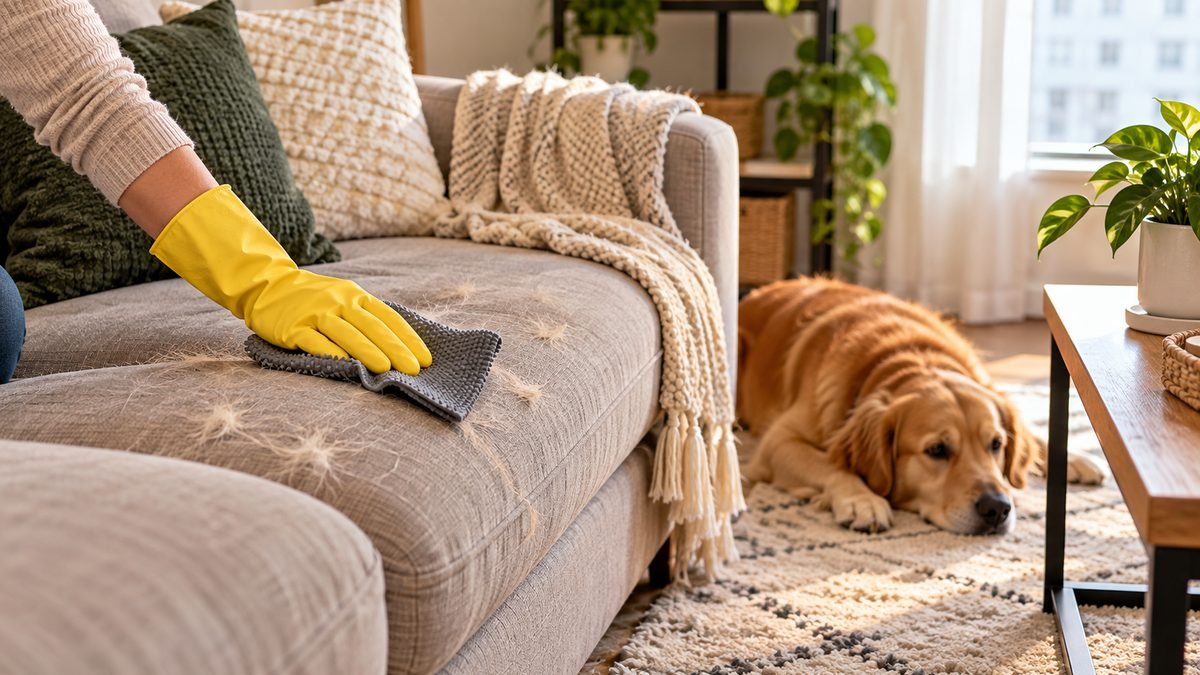
Short answer: the most effective way to keep pet hair under control in a small apartment is to remove it at the source with regular brushing, then use a simple weekly routine for the couch, clothes and floors. No tool will eliminate shedding, and PetMD notes it can’t be fully stopped in dogs. The goal is to make the hair easy to manage so it doesn’t take over your living space.
This guide covers what’s normal and what’s worth a vet visit, how brushing and bathing help, practical ways to lift hair from upholstery, clothing and laundry, and what to know if anyone in your home has allergies. Because dogs and cats are different, we keep the guidance separate: dog points come from dog-specific veterinary pages, cat points from cat-specific ones, and we don’t apply one to the other. The hair-removal methods themselves are mostly from consumer sources and our own editorial suggestions, and we label them. We have not tested any product, and this is general information, not veterinary or medical advice.
Affiliate disclosure: As an Amazon Associate I earn from qualifying purchases. Read our full Affiliate Disclosure.
Product pick
ChomChom Pet Hair Roller
A reusable manual roller marketed for cat and dog hair on furniture, carpet and bedding. We have not tested it.
Check price on AmazonIs your pet’s shedding normal?
Shedding is how pets replace hair, but what’s normal differs between dogs and cats.
Dogs
The Merck Veterinary Manual describes shedding as normal hair replacement, and says that if there are no bald patches or symmetric hair loss, it is likely normal. It becomes a concern when it causes obvious coat loss or bald spots. The AKC says heavier shedding is usual in spring and fall, and VCA says thick-coated dog breeds shed heavily twice a year, while short-haired breeds shed lightly all year.
For dogs, sources suggest checking with your veterinarian for:
- Bald patches or patchy loss (AKC, PetMD; Merck treats bald spots as a sign that shedding is abnormal).
- Irritated skin or itching (AKC, PetMD).
- A sudden increase in hair loss (AKC) or shedding outside the usual seasons (PetMD).
- Increased thirst or urination (PetMD).
VCA adds that excessive shedding in dogs can indicate an underlying problem and says to contact your veterinarian if you have concerns. VCA lists causes such as hormone problems like hypothyroidism, parasites, allergic skin disease and nutrition, and PetMD also lists stress. Only a vet can sort out which applies. VCA also says poor diet can cause a dull coat and excessive shedding in dogs, and advises consulting your vet before choosing a diet.
Cats
International Cat Care says cats usually shed all year, and that much of the loose hair is swallowed. VCA says many indoor cats shed at low levels all year, while some cats, particularly those that spend a lot of time outdoors, have two heavy shedding periods a year, in late spring and late fall. VCA also says many cats shed excessively when they are under stress.
For cats, the sources point to a vet visit for:
- Bald patches or significant hair loss, constant scratching, licking or chewing, scabs, rashes, redness or lumps (ASPCA).
- A dull or dry coat, patchy or all-over excessive shedding, dandruff or greasiness, itching or odor (VCA).
- Excessive grooming. Cornell Feline Health Center says it shouldn’t be ignored, and that owners often notice it only when hair loss or skin lesions appear.
PetMD says hair loss in cats is not an emergency but recommends a vet visit within a few days. VCA lists possible causes of coat problems in cats, including hormone or metabolic disease such as hyperthyroidism, digestive disease, parasites, cancer, and allergic skin disease. Cornell lists fleas or lice, allergies, pain and stress as causes of overgrooming. A cat’s coat also depends on diet. VCA says a balanced, life-stage-appropriate diet supports skin and hair, and an inadequate one can lead to a dull coat and more shedding. Only a vet can tell which cause applies to your cat.
Step 1: Brush the pet
Brushing removes loose hair before it lands on your furniture.
Dogs
The AKC suggests, for short coats, brushing against the direction of growth first and then with it, or using a grooming glove. For long or double coats it suggests a slicker brush, with a de-shedding tool during heavy shedding. Heavy shedders may need brushing several times a week, or daily at peak.
Cats
International Cat Care says shorthaired cats should be groomed at least once a week and longhaired cats at least daily, only for as long as the cat is comfortable, and that daily brushing during a heavy molt removes much of the loose hair. VCA says long, silky or curly coats need daily brushing, and that short coats may need it less often. The ASPCA’s schedule is lighter, one or two brushings a week for cats in general and every few days for long-haired indoor cats, so sources vary and your vet or groomer can help you choose.
For tools, International Cat Care lists a bristle brush, a rubber grooming pad or mitt, and a flea comb for shorthaired cats, and a wide-toothed comb for longhaired cats. It also says not to use scissors on mats, since it is easy to cut the skin, and that severe mats usually need a veterinary or professional groomer. VCA says the same about scissors and recommends clippers for mats.
Brushing also helps with hairballs. Cornell says cats swallow loose hair while grooming, most of it passes in the stool, and daily brushing or combing is the main prevention. Hairballs are more common during seasonal shedding. Cornell says not to give a laxative or special hairball diet without your veterinarian’s approval, and to call a vet for lethargy, refusing food for more than a day or two, or repeated unproductive retching, which can signal a blockage. The ASPCA says to ask a vet if hairballs continue despite regular brushing.
Apartment Therapy, a consumer site, says brushing about two days a week “dramatically cuts down” on loose fur, but this is a consumer-site tip, not a tested result. If you can, brush outdoors or on a balcony or stoop so the hair doesn’t end up back in your home. The AAAAI suggests a non-allergic person do the brushing outdoors for people with pet allergies.
Step 2: Bathe only as needed
For dogs, VCA says most dogs need baths only occasionally and that dog-formulated shampoo should be used, not human or baby shampoo. PetMD agrees about not using human shampoo. VCA adds that dogs with heavy undercoats may benefit from baths in spring and fall. The AKC mentions shedding-control shampoos. Ask your vet how often suits your dog.
For cats, International Cat Care says there is no reason to bathe a healthy cat, and that most cats tolerate baths poorly. VCA says healthy adult cats rarely need baths, that human shampoo, including baby shampoo, is too harsh, and that a cat-formulated hypoallergenic shampoo without added perfumes is the best choice for routine bathing. The ASPCA says a bath may be needed if a cat is very dirty or gets into something sticky or smelly. If your cat seems to need frequent baths, that is a question for your vet.
Step 3: Remove hair from the couch and other fabric
Evidence for specific tools is thin, so treat these as practical suggestions from consumer sources, a general vet-hospital page, or our own editorial ideas, not proven methods:
- Damp rubber glove or slightly wet sponge. Apartment Therapy suggests wiping upholstery with one, and says to rinse the glove off when it is covered in hair. VCA’s page on removing pet fur, written for dog and cat households, also suggests a damp rubber dish glove, and says a clean sponge or rubber squeegee works too.
- A vacuum, twice in alternating directions on carpet. From Apartment Therapy. For allergy households, the AAFA recommends a HEPA vacuum on fabric furniture and carpet weekly.
- Water with a little fabric softener sprayed on upholstery, then vacuumed. VCA’s page suggests this to loosen hair. The same page warns that not every method suits every fabric, so check that your fabric can handle the treatment before you start.
- A reusable pet hair roller. One widely sold option is the ChomChom roller, a manual roller marketed for cat and dog hair on furniture, carpet and bedding. As an Amazon Associate I earn from qualifying purchases. See our affiliate disclosure. We have not tested it.
- A washable throw on the couch. Our own suggestion: wash the throw instead of de-hairing the sofa.
- A lint roller by the door. Also ours: a quick pass before you leave.
We have not tested any of these tools. The ASPCA also notes that regular grooming and vacuuming should minimize the inconvenience of shedding in cat households.
Step 4: Handle the hair on clothes and in the laundry
VCA’s page for dog and cat households suggests putting fur-covered clothes or cushion covers in the dryer with a dryer sheet, a reusable dryer ball or a damp microfiber cloth, and emptying the lint trap after every load. Apartment Therapy suggests a dryer sheet for about 10 minutes, or dryer balls, with hair collecting in the lint trap. These are general tips, not tested results, and we found no authoritative source on the effectiveness of washing-machine methods. Editorial additions that make sense for apartments:
- Run pet-covered items through a short no-heat tumble before washing.
- Clean the dryer lint trap and washer drain after pet-heavy loads.
- At a laundromat, shake items out outdoors first.
Step 5: Floors
Apartment Therapy suggests a microfiber or electrostatic dry mop on hard floors, and vacuuming carpet twice in alternating directions. The AAFA suggests removing carpet and installing hard-surface flooring if possible, and, if you keep carpet, choosing a low pile and steam cleaning it often.
A simple weekly routine
Our own suggestion for a small space:
- Brush the pet (more often during seasonal shedding, within what your vet advises).
- Wipe the couch with a damp rubber glove or sponge.
- Vacuum the couch, rugs and floors.
- Wash the throw and the pet’s bedding.
- Empty the vacuum and clean the lint trap.
If someone in your home has allergies
The allergy sources apply to both cats and dogs. They focus on dander and other allergens, not hair alone, so removing hair isn’t enough. Mayo Clinic says pet allergy is a reaction to proteins in an animal’s skin cells, saliva or urine, that these allergens are also found on fur, and that dander is tiny, can stay airborne, and collects in upholstered furniture and on clothing. The AAAAI says hair length and the amount of shedding don’t determine how allergenic a pet is.
The AAFA says steps like a HEPA air cleaner (run at least four hours a day, especially where people sleep), weekly HEPA vacuuming of fabric furniture and carpet, damp or microfiber dusting, and keeping pets out of the bedroom reduce exposure but do not eliminate it. It also says no pet is truly hypoallergenic, that vacuuming and dusting can stir allergens back into the air, and that dander can persist up to six months after a pet leaves.
The ACAAI says a HEPA purifier may help with pet dander, and notes that HEPA filters are rated to remove up to 99.97% of airborne particles at 0.3 microns (the page attributes the figure to the EPA). It also says there is no scientific data showing ionizer or UV purifiers help allergies, and that the ozone produced by ionic electrostatic room cleaners is a known irritant. The AAAAI notes that medication or immunotherapy may be needed. See an allergist for advice on your situation.
Renting? Protect your deposit
Pet hair that builds up in carpet and upholstery can make move-out cleaning harder (our own observation, not a sourced claim). Our guides on getting your security deposit back with a pet and removing pet odor before moving out cover the final cleaning in more detail, and the enzymatic cleaner guide covers urine stains. Whether a landlord can charge for cleaning depends on your lease and your state, and this is not legal advice.
Our pick for this problem
ChomChom Pet Hair Roller
Who it’s for: Anyone who wants a reusable roller for quick touch-ups on furniture, carpet and bedding.
Skip it if: You need to clear hair from a whole floor or deep carpet. Brushing and vacuuming, as covered above, come first.
Check before you buy: Current price, size and reviews on the Amazon page. We have not tested it.
Check price on AmazonPaid link. As an Amazon Associate I earn from qualifying purchases.
Frequently asked questions
How do I get pet hair off a couch?
Consumer and general sources suggest a damp rubber glove or sponge, or a fabric-softener-and-water spray followed by vacuuming (test a hidden spot first). Using a washable throw means you wash it instead of de-hairing the sofa.
Can I stop my dog or cat from shedding?
No. PetMD says shedding in dogs can’t be fully stopped, and International Cat Care says cats usually shed all year. Regular brushing can reduce loose hair, and your vet can advise on diet or a medical cause.
How often should I brush my pet?
It depends on the species and coat. For dogs, the AKC says heavy shedders may need brushing several times a week, or daily at peak. For cats, International Cat Care says at least weekly for shorthaired cats and at least daily for longhaired cats, while the ASPCA suggests less often, so ask your vet or groomer.
What does it mean if my pet is losing a lot of hair?
It can be seasonal, but bald patches, skin inflammation, itching, overgrooming or a sudden increase are reasons to see a vet.
Do air purifiers remove pet hair?
Air purifiers address airborne particles like dander, not hair that has settled. The ACAAI says a HEPA purifier may help with dander.
Sources
Dogs:
- Merck Veterinary Manual, Hair Loss (Alopecia) in Dogs (updated May 2025)
- AKC, Dog Shedding: What to Expect and How to Manage It (updated August 5, 2026)
- VCA Animal Hospitals, Coat and Skin Appearance in the Healthy Dog (updated March 31, 2026)
- PetMD, Excessive Shedding in Dogs (November 16, 2023)
Cats:
- International Cat Care, Grooming your cat (updated September 26, 2025)
- VCA Animal Hospitals, Coat and Skin Appearance in the Healthy Cat (updated March 31, 2026)
- VCA Animal Hospitals, Grooming and Coat Care for Your Cat (updated February 13, 2026)
- ASPCA, Cat Grooming Tips
- Cornell Feline Health Center, Hairball Facts and Why do cats lick too much?
- PetMD, Alopecia in Cats (August 22, 2025)
Cleaning and allergies (cats and dogs):
- VCA Animal Hospitals, Tips to get pet fur off clothes and upholstery
- Apartment Therapy, How to Remove Pet Hair Everywhere (September 22, 2022)
- Mayo Clinic, Pet allergy (September 5, 2025)
- AAFA, Pet and Dog Allergies (modified January 7, 2025)
- ACAAI, Air Filters (May 13, 2022)
- AAAAI, Pet Allergy (page dated July 9, 2026)
This article is general information and is not veterinary, medical or legal advice. We have not tested any pet hair tool. See your veterinarian about shedding concerns and an allergist about allergy symptoms.