
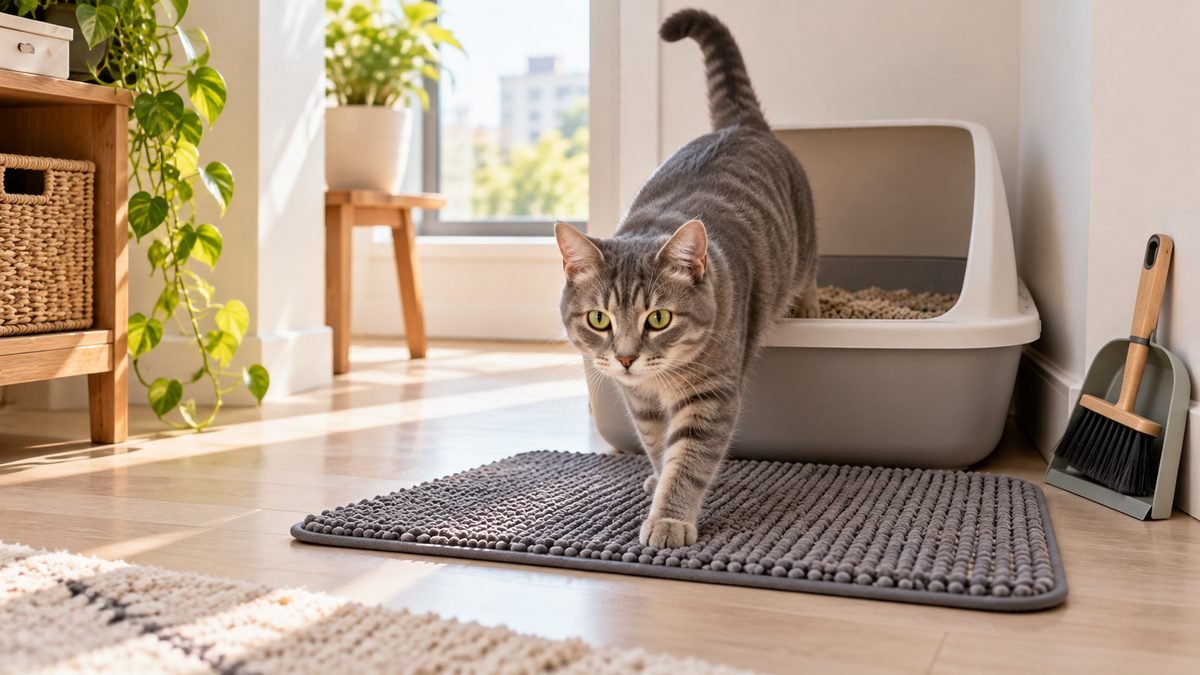
Short answer: you can’t stop litter tracking completely, but you can cut it down a lot by combining three things: a litter setup your cat actually likes, a catch zone just outside the box, and a quick daily sweep. The key rule is to fix the floor, not the box. Veterinary sources are consistent that cats avoid litter boxes they dislike, so any change meant to reduce mess should never come at the cost of your cat’s comfort.
That matters in a small apartment, where a few stray granules end up on the bedroom rug, the kitchen tile and your socks. This guide separates what veterinary and animal-welfare sources say about litter preferences from our own practical suggestions for managing the mess, and it labels each one. We have not tested any litter, mat or box, and no source we reviewed measured tracking directly. It is general information, not veterinary advice.
Affiliate disclosure: As an Amazon Associate I earn from qualifying purchases. Read our full Affiliate Disclosure.
Product pick
Gorilla Grip Litter Mat
A coiled-mesh litter mat. The listing offers several sizes (we looked at the 24 x 17 inch gray style on October 9, 2026), so measure the space beside your box first. We have not tested it.
View on AmazonWhat the research says (and doesn’t say)
We reviewed Cornell Feline Health Center, the ASPCA, Humane World for Animals, VCA Animal Hospitals and Ohio State University materials for this article. None of them tests how much litter different products track. What they do cover is what cats prefer, and that is useful, because it sets the limits for any tracking fix.
- Most cats prefer unscented, finer-textured litter (Cornell, Ohio State, Humane World), at roughly 1 to 2 inches deep (Cornell and ASPCA; Humane World says about 2).
- The ASPCA says most cats prefer clumping, unscented litter. VCA says most prefer clumping litter, though not all.
- The ASPCA says most cats dislike liners and lids. Cornell says many cats dislike liners, and Humane World says liners can catch claws and lids can limit visibility.
- Changing litter suddenly can make a cat avoid the box. Cornell recommends switching gradually by mixing a little new litter into the old, and Humane World advises sticking with a litter your cat likes. VCA advises going back to the previous litter if problems start after a change.
In other words, the moves people usually reach for, such as a different litter, a deeper fill, a hooded box or a liner, are exactly the ones the sources caution about. That is why this guide puts the fixes around the box rather than inside it.
Step 1: Keep the litter setup your cat likes
Before you buy anything, check that your current setup matches the basics. Our editorial suggestion is to treat these as guardrails and not to change them just to reduce mess:
- Unscented, fine-to-medium texture litter.
- About 1 to 2 inches of litter, not a deep fill.
- No liner, and no lid if your cat seems to dislike one.
- A box big enough to turn around in comfortably. Our litter box buying guide covers size and type for small spaces.
If you are thinking of trying a different litter to see whether it tracks less, Cornell recommends doing it gradually, by mixing new litter into old, and watching your cat. The ASPCA suggests side-by-side trials. If your cat starts avoiding the box, VCA’s advice is to go back to the previous litter.
Step 2: Build a catch zone around the exit
Granules travel on paws, so the practical goal is to give them somewhere to fall off before they reach your floor. These are editorial suggestions, not tested or published protocols:
- Put a textured mat at the box exit. A mat in front of the box gives paws something to brush against. Choose one that is easy to shake out or wipe, and make sure it extends past the opening instead of tucking under it.
- Place the box on an easy-clean surface. Hard flooring is simpler to sweep than carpet, and a rug next to the box is where tracked litter hides.
- Think about the path out. Many boxes have a single exit your cat uses every time. A mat there does more than one placed at the side. Cornell does recommend a box with more than one way out for cat comfort, so do not block exits just to control mess.
- Keep a dustpan or small handheld vacuum nearby. Cleanup that takes ten seconds happens daily. Cleanup that means getting the vacuum out from a closet often doesn’t.
If you decide to add a litter mat, treat it as a convenience product. As an Amazon Associate I earn from qualifying purchases. See our affiliate disclosure. One widely sold example is the Gorilla Grip litter mat, a coiled-mesh mat. The listing offers several sizes (we looked at the 24 x 17 inch gray style on October 9, 2026), so measure the space beside your box first. We have not tested this mat or any other, and we can’t say how well a particular one works.
Step 3: Make cleanup a daily habit
Litter that lands on the floor and gets walked on spreads. Sources recommend scooping clumping litter at least daily (Cornell, ASPCA, Humane World, VCA), and it is a natural moment to sweep the catch zone too.
A simple routine that fits a small apartment:
- Scoop the box.
- Shake or wipe the mat over the box or a trash bag.
- Sweep or vacuum the floor within a couple of feet of the box.
- Top up the litter so the depth stays consistent. VCA suggests refilling after scooping to keep the level steady.
- Do a full change and box wash on a regular schedule. Sources vary: Humane World says every two to three weeks and VCA two to four weeks for clumping litter if you scoop daily, while the ASPCA says weekly. Humane World suggests washing the box with mild dish soap and avoiding ammonia, citrus or harsh chemicals.
Don’t flush scooped clumping litter. VCA advises against it.
Where you put the box affects the mess
Placement is covered in more depth in our guide on how many litter boxes you need and where to put them, so here is the short version for tracking. The sources agree on a quiet, private spot. Humane World adds that the box should be away from food and water and not near loud appliances such as washers, dryers or furnaces. Within those limits, our editorial suggestion is to choose a spot with an easy-clean floor and a short, uncarpeted route to wherever your cat goes next. If the only quiet spot has carpet, a larger mat or a washable runner may help, but the cat’s comfort comes first.
What not to do
- Don’t switch to a scented litter to cover odor while you try to solve tracking. Sources say many cats dislike strong scents.
- Don’t add a liner or lid purely to contain mess if your cat dislikes them.
- Don’t swap litters overnight. A sudden change can cause box avoidance.
- Don’t scold a cat for tracking. Tracking is an ordinary side effect of using a box. It isn’t a behavior to correct.
If a cat suddenly stops using the box or starts going elsewhere, treat that as a signal to call your veterinarian, since house-soiling can have medical causes. If urine accidents happen, our guide to enzymatic cleaners for pet urine covers cleanup. For help choosing a box that suits a small space, see our litter box buying guide.
Frequently asked questions
Can I stop litter tracking completely?
No source we reviewed suggests that is realistic. Think of this as reducing, not eliminating. A catch zone and a daily sweep keep most of it contained.
Does litter type change how much tracks?
We could not find an authoritative source that measures this. Cat preference is better documented: most cats prefer unscented, finer litter. If you try a different type to see whether it tracks less, do it gradually and watch for box avoidance.
Is a covered box better for tracking?
The ASPCA says most cats dislike lids, Cornell prefers uncovered boxes, and Humane World says covered boxes can trap odor and limit visibility (it suggests an open box if your cat avoids a covered one). We would not choose a covered box solely for tracking.
How often should I clean the area around the box?
Daily is a good rhythm, since the sources recommend daily scooping anyway. Sweeping the catch zone at the same time keeps litter from spreading.
Are there health precautions for handling litter?
The CDC explains that the toxoplasmosis parasite in cat feces is not infectious until one to five days after it is shed, so cleaning the box daily removes feces before then, and it advises wearing gloves for soil that may contain cat feces. If you are in a higher-risk group, ask your healthcare provider for guidance.
Sources
- Cornell Feline Health Center, Feline Behavior Problems: House Soiling (last updated January 2015)
- ASPCA, Litter Box Problems
- Humane World for Animals, How to Litter Train a Kitten or Cat
- VCA Animal Hospitals, Cat Behavior Problems: House Soiling (edited July 18, 2019)
- Ohio State University Indoor Pet Initiative, Keeping Cats Indoors
- CDC, Preventing Toxoplasmosis (January 30, 2024)
This article is general information and is not veterinary advice. We have not tested any litter, mat or box. If your cat changes its litter box habits suddenly, contact your veterinarian.