
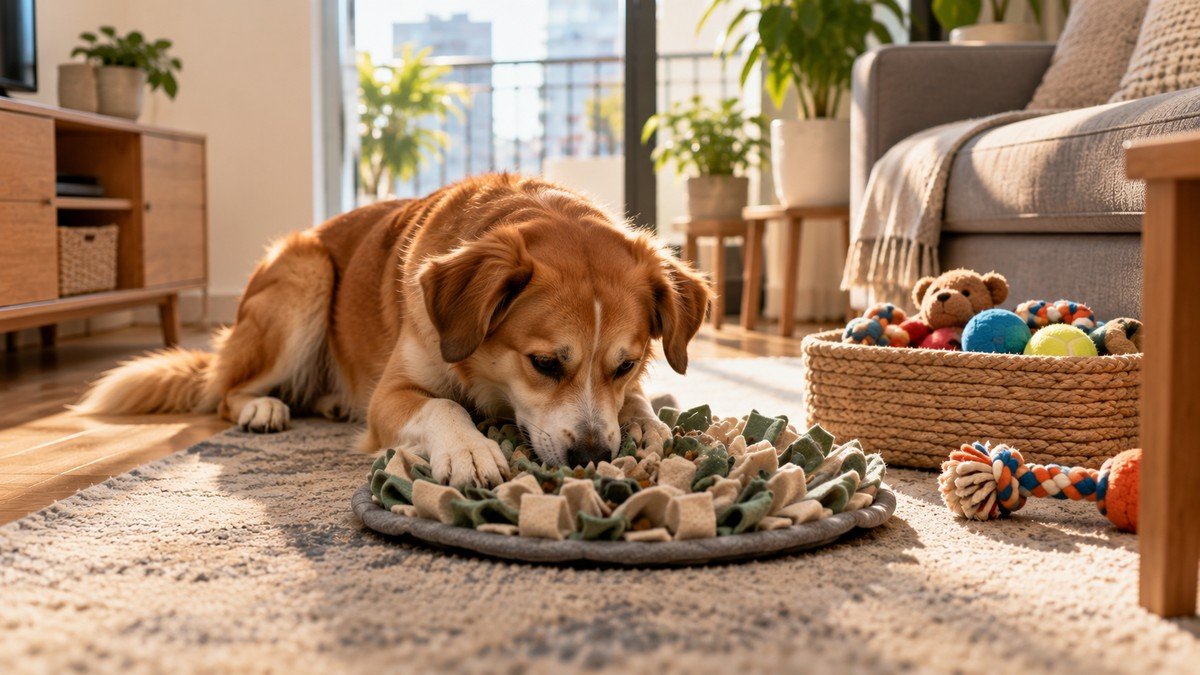
If you live in an apartment or small rental with a dog, you’ve probably come home to at least one scene you didn’t expect: a chewed-up shoe, a shredded pillow corner, or a doorframe with fresh scratch marks. It’s easy to feel like you have a “bad” dog. Most of the time, you don’t — you have a bored, under-stimulated, or anxious dog, and in a small space with no yard to burn off energy, those feelings show up fast and land squarely on your furniture.
The good news is that this is one of the most well-understood behavior problems in dog care, and it doesn’t require a backyard to fix. It requires knowing what’s actually driving the behavior, and building a handful of small habits around it.
Boredom, Not “Bad Behavior”
According to the ASPCA, dogs chew for a mix of reasons — teething, jaw exercise, dental health — but boredom is one of the biggest drivers in adult dogs. As the ASPCA puts it, “Bored dogs tend [to] look for ways to entertain themselves, and chewing is one option.” A dog left alone in a one-bedroom apartment for eight or nine hours, with no outlet for normal behaviors like chewing, sniffing, and chasing, is going to find its own outlet — and it’s usually not one you’ll like.
This matters because it changes how you should respond. Punishing a dog after the fact for chewing something while you were out doesn’t address the actual cause, and the ASPCA’s broader behavior guidance is consistent on this: destructive chewing linked to boredom is treated as a management and enrichment problem, not a discipline problem.
Boredom vs. Separation Anxiety: They Look Similar, But Aren’t the Same
Before you start buying puzzle toys, it’s worth figuring out which problem you actually have, because the fixes are different.
Boredom tends to show up as chewing, digging, or general restlessness that can happen whether or not you’re home — it’s about unspent energy and lack of mental stimulation.
Separation anxiety is specifically tied to being left alone. The ASPCA describes the signs as dogs that “urinate, defecate, bark, howl, chew, dig or try to escape” only (or mainly) when separated from their owner, often starting with drooling or visible anxiety as you get ready to leave, and sometimes including pacing or damage concentrated near doors and windows. The ASPCA also notes that separation anxiety shows up more often in dogs who were previously rehomed or adopted from a shelter, which may reflect earlier loss or disruption.
A simple way to tell the difference at home: if the damage is scattered and happens over time (even when you’re around), it’s more likely boredom. If it’s concentrated near exits, starts the moment you leave, and comes with obvious distress as you prepare to go, separation anxiety is more likely — and that calls for a different, more structured plan (see the section below).
Building an Apartment Enrichment Routine That Doesn’t Need a Yard
The ASPCA’s own guidance on canine enrichment is built around the idea that dogs need regular outlets for natural behaviors — “playing, chasing, smelling, chewing and scavenging” — and that these can be created indoors with ordinary household items. None of this requires a yard; it requires structure.
Turn mealtime into mental work. Instead of a bowl, use a food puzzle. The ASPCA’s own DIY suggestions include a muffin tin with kibble hidden under tennis balls, treats folded into an empty paper towel roll (twist the ends closed), or a snuffle mat, which hides kibble in a high-pile fabric mat so your dog has to sniff and forage for it. All three slow down eating and turn a two-minute meal into ten or fifteen minutes of problem-solving.
Rotate toys instead of leaving everything out. The ASPCA specifically recommends rotating a dog’s chew toys every couple of days rather than leaving the same toys accessible all the time, “so that he doesn’t get bored with the same old toys.” Keep two or three toys out and the rest in a closet or bin; swap them every few days.
Give the nose something to do. Scent work — hiding a few treats around a room and letting your dog search for them, or running basic “find it” games — taps into a dog’s sense of smell in a way that’s mentally tiring in a good way, and it works fine in a studio apartment.
Use your furniture as an obstacle course. The ASPCA’s enrichment guide even suggests building simple indoor agility setups from things you already own — a cushion to jump over, a low coffee table to go under, a hallway for a straight-line recall game — plus a homemade flirt pole (a rope and toy tied to a pole, essentially a DIY version of a cat wand toy for dogs) for a few minutes of controlled chasing.
One caution directly from the ASPCA: supervise any homemade enrichment toy and remove it right away if your dog starts trying to actually eat pieces of it (paper, fabric, tennis ball felt) rather than just work at it.
Don’t skip real exercise. Enrichment toys are not a replacement for a walk. The ASPCA lists daily walks, off-leash play, tug and fetch, and even structured dog sports like agility or flyball as part of a normal activity plan for a dog — all of which are realistic for an apartment dog if you use a nearby park, a fenced dog run, or even hallway fetch for a short-legged breed. A tired dog, mentally and physically, is a dog with a lot less energy left over for your baseboards.
If You Have to Leave a Dog Alone for Several Hours
For a dog that handles solitude reasonably well, the ASPCA notes that crating or confining to a small, dog-proofed room for up to about six hours can be appropriate — but only paired with real exercise and attention during the hours you are home. Confinement without that trade-off just moves the boredom problem into a box.
If your dog is a puppy, new to your home, or shows any separation-anxiety signs, don’t default to long stretches of confinement as the fix — deal with the underlying anxiety first (next section), since confinement alone can make a genuinely anxious dog more distressed, not less.
When It’s Separation Anxiety, Not Just Boredom
If you’ve recognized your dog in the separation anxiety description above, the ASPCA’s treatment approach is more structured than “give him a toy”:
- For mild cases: giving your dog a food-stuffed puzzle toy that takes 20–30 minutes to finish right as you leave can build a positive association with your departure.
- For moderate to severe cases: the ASPCA recommends gradual desensitization — starting with extremely short absences (sometimes just stepping outside the door for seconds) and slowly building up the time apart over many sessions, without skipping ahead. Critically, the ASPCA notes the dog shouldn’t be left alone outside of these controlled practice sessions during this process, which usually means arranging a sitter, daycare, or a trusted neighbor in the meantime.
- Don’t punish the behavior. The ASPCA is direct on this point: anxious behaviors “are not the result of disobedience or spite,” so punishment after the fact doesn’t fix anything and can make the anxiety worse.
- Get professional support for anything beyond mild cases. The ASPCA recommends working with a Certified Applied Animal Behaviorist or a veterinary behaviorist, who can also evaluate whether anti-anxiety medication makes sense alongside a behavior plan.
This is also where apartment living adds real pressure that many general dog-behavior guides don’t mention: a dog with unmanaged separation anxiety that’s barking, howling, or scratching at the door isn’t just a training problem — it’s often the exact thing that turns into a noise complaint from a neighbor or a note from your property manager. If that’s already happening, see Dog Barking and Apartment Noise Complaints for what the complaint process actually looks like and how to get ahead of it.
If confinement while you’re out is part of your plan, it’s worth pairing it with the damage-prevention basics covered in How to Prevent Your Dog or Cat From Damaging Your Rental — a bored or anxious dog and an unprotected rental are a bad combination regardless of which one you fix first.
A Realistic Weekly Routine for a Small-Space Dog
You don’t need to overhaul your life. A workable baseline for most apartment dogs looks like:
- One real walk or off-leash play session daily, sized to your dog’s energy level and breed.
- At least one meal served as a puzzle or snuffle-mat session instead of a plain bowl.
- Toys rotated every two to three days rather than left out permanently.
- A few minutes of scent games or indoor “obstacle course” play on lower-energy days when a full walk isn’t possible.
- Closer attention (not automatically less exercise) on days your dog will be alone longer than usual.
None of this requires new square footage. It requires treating indoor enrichment as a real part of your dog’s day, the same way food and water are — because to your dog, mental stimulation isn’t a bonus, it’s a basic need that a small apartment makes easier to accidentally skip.
If a crate is part of your routine, see where to put a dog crate in a small apartment.