
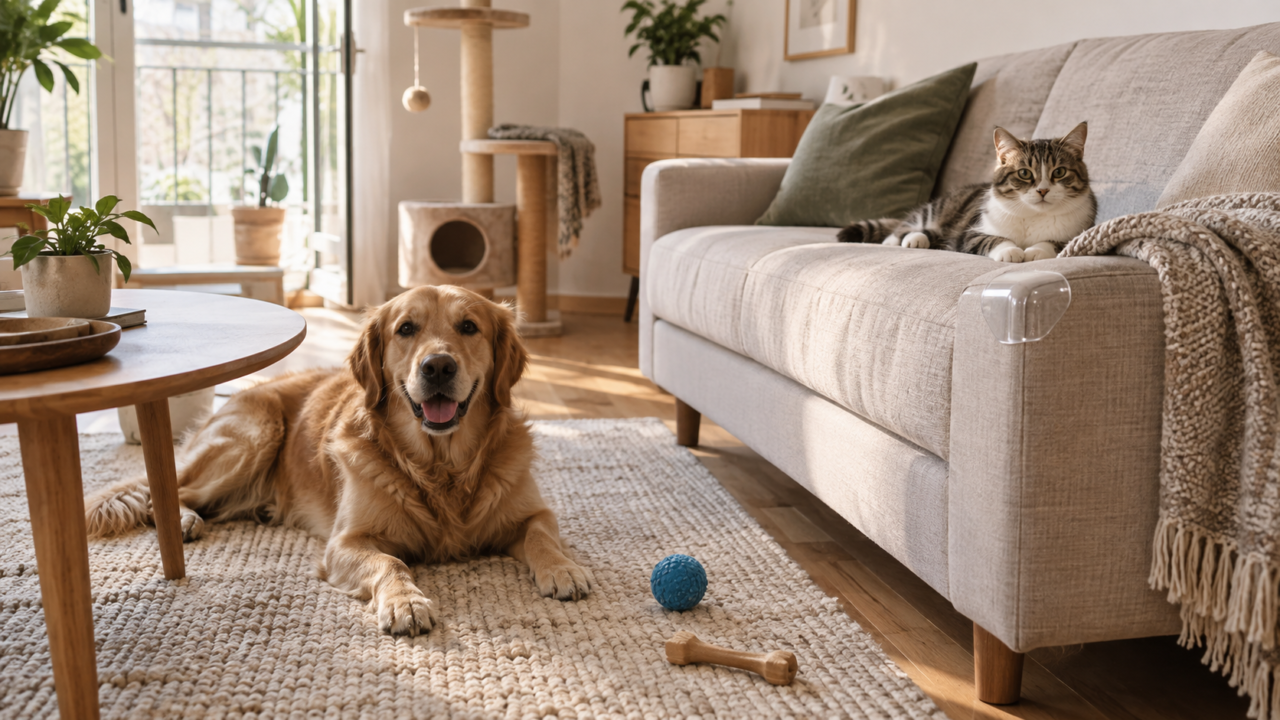
A Renter’s Practical Product Guide
Living with a pet in a rental is mostly ordinary life: food bowls in the kitchen, a leash by the door, a favorite spot on the sofa and a few toys that somehow end up everywhere. The tricky part is that some of the things pets do naturally — scratching, chewing, digging, tracking in dirt or jumping onto furniture — can become a problem when the home belongs to someone else.
The goal is not to make your apartment look like a pet-free showroom. It is to make the home easier for both of you to live in while reducing the kinds of damage that are reasonably preventable.
This guide focuses on products and setup choices that can help renters manage common trouble spots. It does not guarantee that a rental will remain damage-free or that a security deposit will be returned in full.
The Best Pet-Proofing Starts With the Pet, Not the Product
It is tempting to search for one product that will solve a chewing, scratching or digging problem. In practice, the setup usually works better when you ask a simpler question: what is my pet trying to do, and where can I give them an acceptable place to do it?
The ASPCA makes a similar point with destructive dog chewing. Dogs naturally chew, and simply removing every tempting object is not enough. Dogs need appropriate things to chew, clear boundaries and, when necessary, supervision and environmental management.
The same idea applies to cats. Scratching is normal cat behavior. The useful goal is not to eliminate scratching, but to make the appropriate scratching surface more appealing than the sofa or carpet.
1. Protect the Areas Your Pet Can Reach Easily
Start at floor level. Shoes, charging cables, children’s toys, loose clothing and bags are all much more interesting to a curious pet than they are to you. If an item would be expensive or difficult to replace, do not rely on training alone to protect it.
Closed baskets, cabinets and storage bins are often more useful in a small rental than another decorative object. The best storage solution is the one that makes the unwanted item physically harder to reach.
For dogs who are still learning what belongs in their mouths, the ASPCA recommends putting valuable objects away until the chewing behavior is under better control.
2. Give Dogs Something Better to Chew
Chewing is normal. The problem is choosing the wrong target.
Keep a small selection of appropriate chew toys rather than leaving the same few toys scattered around the apartment indefinitely. Rotating them can keep familiar toys interesting. Puzzle toys can also give a dog something to work on when boredom is part of the problem.
Choose chew products according to your dog’s size and chewing style. The ASPCA advises following product directions and supervising dogs with chews, particularly because pieces can break off and become a choking or obstruction risk.
If destructive chewing appears suddenly, becomes extreme, or is connected with being left alone, it may be more than a simple ‘needs a better toy’ problem. In those situations, veterinary or qualified behavior advice is more useful than buying another product.
3. Give Cats a Scratching Spot They Actually Want to Use
A scratching post hidden in the corner is not automatically going to beat the sofa. Placement matters.
The ASPCA recommends sturdy scratching surfaces and notes that cats can have different preferences for the material, orientation and shape of a scratching surface. Some cats prefer vertical posts, while others prefer horizontal pads.
If your cat repeatedly scratches one particular piece of furniture, placing an appropriate scratching surface nearby can make the alternative much easier to discover.
For a rental, stability is especially important. A tall scratching post that wobbles every time the cat uses it is unlikely to become a favorite. A compact but solid post or scratcher may be a better fit for a small apartment.
4. Protect Corners and Baseboards
Corners and baseboards are easy to forget until a pet discovers them. Puppies may chew them. Cats may rub against or scratch them. A bored pet may simply decide that a particular corner is fascinating.
Before attaching anything to painted walls or trim, check the manufacturer’s removal instructions. Adhesive guards can be useful in some homes, but a product being described as ‘renter-friendly’ is not the same thing as a guarantee that it will leave no residue or discoloration.
If you can solve the problem by changing access — moving furniture, blocking a small area with a freestanding barrier, or placing an appropriate scratching or chewing option nearby — that can be preferable to attaching something permanently.
5. Think About Doors and Entryways
The entrance to an apartment gets a surprising amount of punishment. Wet paws, grit, mud and excited dogs running in after a walk can turn a small patch of flooring into the busiest area in the home.
A washable entry mat can catch some of that mess before it spreads. Keep a towel or pet-wiping cloth close to the door so the cleanup happens at the same place every time.
If you use a gate to control access to part of the apartment, look for a setup that suits the opening and does not require drilling unless your lease and landlord allow permanent installation. Pressure-mounted or freestanding options may be worth considering, but the exact installation requirements and suitability depend on the doorway and the pet.
6. Protect Furniture Without Turning the Apartment Into a Fortress
You do not need plastic covers over every sofa and chair. Instead, look at the furniture your pet uses most.
A washable throw can make sense on a favorite sofa. A dedicated pet bed can give a dog a comfortable place beside the couch instead of on it. A cat perch or window bed can sometimes give a cat an alternative to the arm of the sofa.
For furniture that moves, felt or silicone pads under the legs are a simple precaution. They protect against a different kind of damage than pet scratching, but they are still part of a sensible rental setup.
7. Keep Pet Gear Contained
Pet-proofing is easier when the supplies themselves are organized. Leashes, harnesses, toys, grooming tools, food containers and cleaning supplies tend to spread across a small apartment surprisingly quickly.
A narrow shelf, a few woven baskets or a small cabinet can keep the gear together without taking over the room. For food, use containers appropriate for pet food storage and follow the food manufacturer’s storage directions rather than assuming any decorative jar is suitable.
The practical advantage is bigger than appearance: when the right toy or leash is easy to reach, you are more likely to use it before your pet finds something else.
8. Use Gates and Barriers Strategically
A barrier can be useful when you need to keep a dog away from a room, protect a new piece of furniture, or create a safe area while you are not able to supervise.
For renters, the first question is how the barrier attaches. Freestanding and pressure-mounted products may be easier to use without drilling, but they are not automatically suitable for every doorway, wall or pet.
Check the manufacturer’s measurements, installation instructions and weight or pressure requirements. If the product will be used around a child as well as a pet, follow the manufacturer’s child-safety guidance separately.
9. Don’t Rely on Deterrent Sprays Alone
Taste or scent deterrents can be one tool for certain chewing problems, but they are not a substitute for teaching the pet what is appropriate to chew.
The ASPCA specifically notes that deterrents work best as part of a larger approach: dogs still need appropriate things to chew and need to learn the difference between acceptable and unacceptable objects.
If you use any spray around a pet, follow the product label carefully and make sure it is intended for the surface and the animal involved.
10. Make the Apartment Boring in the Right Places
A lot of successful pet-proofing is surprisingly unexciting. Shoes go in a closed cabinet. Laundry goes in a hamper. Cables are routed out of reach. Trash has a lid. Food stays where the pet cannot reach it.
The ASPCA’s advice for dog-proofing follows this same logic: make it easy for the dog to succeed. The fewer tempting objects that are available, the fewer times you have to correct the same behavior.
A Simple Rental Pet-Proofing Checklist
- Store shoes, laundry and other chewable items behind closed doors or in secure containers.
- Keep cables and chargers out of easy reach.
- Give dogs appropriate chew toys and rotate them rather than leaving every toy out at once.
- Give cats a stable scratching surface suited to their preferred orientation and material.
- Place scratching options near furniture the cat already targets.
- Use washable mats at busy entrances.
- Use furniture-leg pads on pieces that move.
- Consider freestanding or pressure-mounted barriers where appropriate, after checking the installation requirements.
- Check adhesive products for removal instructions before using them on painted walls, trim or floors.
- Photograph existing damage when you move in and keep the records with your lease paperwork.
What to Buy First
If you are starting from scratch, resist the urge to buy twenty different pet-proofing products. Start with the problem you can actually see.
- Dog chewing furniture or shoes → appropriate chew toys + closed storage + supervision/management.
- Cat scratching the sofa → sturdy scratcher placed near the target furniture.
- Dirty entryway → washable mat + towel or pet-wiping setup by the door.
- Pet getting into restricted rooms → suitable freestanding or pressure-mounted barrier.
- Pet gear taking over the apartment → compact shelf, baskets or cabinet.
- Furniture sliding or scratching → felt or silicone furniture-leg pads.
When a Product Is Not the Real Solution
Sometimes the behavior is telling you something. A dog that becomes destructive mainly when left alone may need a different kind of help. A cat that suddenly changes its scratching or other behavior may need a closer look at what changed in its environment.
The point of a product guide is to make everyday management easier, not to turn every behavior problem into a shopping problem. When the behavior is persistent, severe or unusual, professional veterinary or behavior guidance is the better next step.
A Note About Security Deposits
Pet-proofing can reduce preventable wear, but it cannot guarantee what a landlord will consider damage. Keep your lease, move-in photos and move-out photos together. If there is a disagreement about a charge, the relevant lease terms and the law that applies to the rental matter more than whether a product was marketed as ‘renter-friendly.’
Related guides: how to stop cats scratching furniture in a rental and where to put a dog crate in a small apartment.
A Note From PawSpace Living
This guide is designed around everyday rental life rather than a perfect pet-proofed home. The best setup is usually the one that fits your apartment, your pet and your routine well enough that you can actually maintain it.
We have not personally tested the products or product categories mentioned here. Always follow the manufacturer’s instructions, especially for chews, barriers, adhesives and products used around pets.
This article is for general informational purposes and is not legal, veterinary or professional animal-behavior advice.