
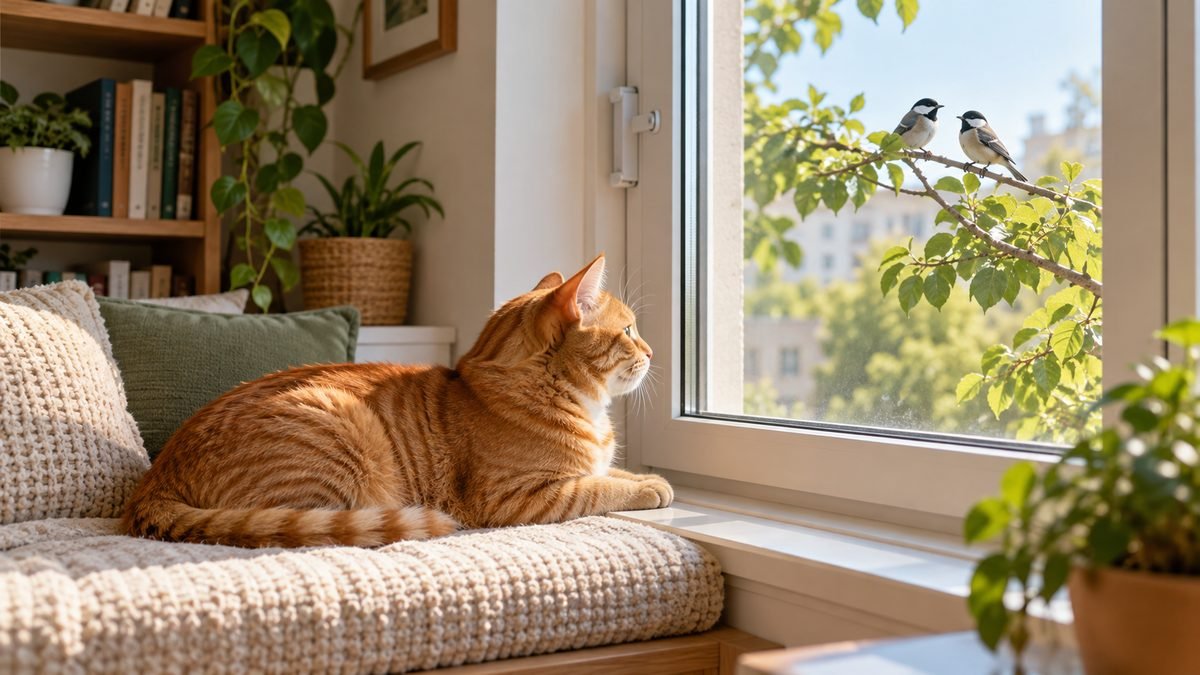
Short answer: cats rarely jump out of windows on purpose. They fall. A bird flies past, something startles them, or a paw slips on a narrow ledge, and a cat that was calmly watching the street is suddenly outside. Veterinarians call the resulting injuries “high-rise syndrome,” and in a rental, where you may not control the windows or balcony, it is worth knowing what the veterinary sources actually say before the weather warms up and windows open.
This guide sticks to what veterinary and animal-welfare organizations have published, and it is deliberately cautious. Where the evidence runs out, we say so. It is general information, not veterinary or legal advice.
Why cats fall
The ASPCA’s guidance on high-rise syndrome says that cats do not deliberately jump from high places that would be dangerous. Instead, they fall by accident from windows, terraces and fire escapes. A cat that is distracted by a bird can lose its balance, and cats can have trouble getting a secure grip on window ledges and brick or concrete surfaces (ASPCA).
The Animal Medical Center of New York (AMC) lists several common causes: windows opened too wide, loose screens that a cat pushes through, and sudden noises such as a vacuum cleaner that startle a cat near an opening. It also names apartment balconies, unscreened windows and even second-floor landings as fall locations, and notes that kittens and young cats fall more often because of inexperience and curiosity (AMC). WebMD, in an article medically reviewed by a veterinarian, adds that a loud noise or strong breeze can startle a cat, and that falls usually happen through open, unscreened windows or from fire escapes (WebMD).
The pattern is consistent across these sources: this is an accident problem, not a behavior problem.
A low floor is not automatically safe
It is natural to assume that the risk belongs to people on the 20th floor. The ASPCA says otherwise: cats in one- or two-story buildings are still at risk, because a shorter fall may leave less time to correct posture, and landing with splayed feet can cause severe head and pelvis injuries (ASPCA). WebMD makes the same point about short falls (WebMD). So a second-floor apartment is not a reason to relax about an open window.
Ground-floor windows are a slightly different problem, and it helps to keep the two apart. On a higher floor, the main danger is injury from the fall itself. On the ground floor, a cat that gets through an open window may not fall far at all, but it is suddenly outdoors, unsupervised and possibly unfamiliar with its surroundings, so the danger shifts toward getting lost or being hurt outside. The sources we reviewed describe injuries from falls from windows and from one or two stories up. We did not find a source that measures ground-floor escapes, so we are not claiming a ground-floor window is safe. The advice is the same at every level: do not leave a cat with access to an open, unprotected window.
How serious the injuries can be
The injuries described by the ASPCA include shattered jaws, punctured lungs, and broken limbs and pelvises, and falls can be fatal (ASPCA). AMC lists chest and lung injuries, head and facial injuries, limb fractures, and abdominal organ injuries or bleeding. Treatment can involve oxygen for chest trauma, surgery for broken bones or abdominal injuries, and dental work for jaw and tooth fractures (AMC). WebMD states plainly that cats “can and do die from falls.”
Outcomes depend on the height, the cat’s body position and the surface it lands on. Older or less agile cats may be hurt more badly because they cannot reposition in time or absorb the impact (AMC).
Prevention comes first: keep cats away from unprotected openings
The most reliable approach the sources describe is simple: do not let a cat have access to an open window or balcony that is not properly protected.
- If a window has no screen, keep it closed. WebMD and AMC both give this advice (WebMD, AMC).
- Keep balcony doors shut. AMC recommends keeping balcony doors tightly closed at all times and keeping pets off open balconies. It also suggests not feeding birds on the balcony, since birds are a common distraction (AMC).
- Do not assume you can watch closely enough. Falls happen in a second, usually when a cat is startled or distracted. Supervision does not remove the risk, so do not rely on it as a substitute for keeping the opening closed or protected.
- A practical house rule (our own suggestion, not a published veterinary protocol): if you want a window open for air, open it in a room your cat cannot enter, and close the door to that room.
What about screens?
The ASPCA recommends snug, sturdy screens in all windows, with adjustable screens wedged tightly into the frame. It also warns that childproof window guards do not protect pets, because cats can slip through them (ASPCA). AMC, however, lists loose screens as one of the ways cats fall (AMC).
Here is the limit of what we can tell you. None of these sources tests specific products, and they do not establish that any particular ordinary insect screen, tension-fit or removable screen, adhesive netting or similar no-drill product will hold a cat that pushes or leaps against it. Because renters are often limited to removable, no-drill options, this matters. We do not treat those options as reliable fall protection, and we do not recommend any of them for that purpose.
Landlord approval is also not a safety test. Where a lease requires permission, a landlord saying yes to an installation tells you the landlord allows it. It does not tell you the installation can withstand a cat’s weight or movement. If you want to protect a window more than a closed window and a closed door do, ask the manufacturer for documented load or strength information, consider having the work done by a qualified installer, and talk to your veterinarian. Until then, closing the window is the more dependable choice.
Balconies and enclosures
Unenclosed balconies are a known fall location, which is why AMC advises keeping cats off open balconies (AMC). Both AMC and WebMD mention a screened enclosure, sometimes called a “catio,” as a way to give a cat outdoor access, and WebMD refers to predesigned full-screen enclosures for terraces and windows (WebMD).
As supplementary information only, the Cat Protection Society of NSW in Australia publishes a balcony-safety factsheet describing balcony enclosures and full-height cat netting, and it advises sitting on the balcony with your cat before leaving it unattended (Cat Protection Society of NSW). It is a general information sheet from another country. It states that it is not professional advice and does not endorse specific products. It is not evidence that any particular netting or do-it-yourself installation is safe, and we do not offer it as such. In a rental, an enclosure or netting may change the building, so check your lease and get written permission where it is required. That permission, where needed, says nothing about whether the structure is strong enough.
A renter’s checklist
Practical steps that do not depend on unproven products:
- Inspect every window and balcony door. Note which windows open, how far they open, whether each has a screen, and whether any screen is loose, bent or torn. AMC lists loose screens among the causes of falls (AMC).
- Document existing conditions. Take dated photos of the windows, screens and balcony when you move in, and again if anything changes. This protects you if a question comes up later about damage. Our guide to getting your security deposit back with a pet explains why move-in and move-out records matter.
- Read your lease. Look for rules on window treatments, screens, balcony use, and alterations. Rules differ by lease and by location.
- Before changing anything, check what your lease requires and get written permission where it is required. That includes replacing screens, adding guards, attaching netting or building an enclosure. Keep any reply you receive. Permission, where needed, only settles the lease question. It does not tell you whether the change is safe.
- Report damaged or missing screens to your landlord in writing, and keep those windows closed until they are fixed.
- Know the cost side. If a pet changes what you owe each month or at move-out, see our explainer on pet deposits, pet fees and pet rent.
We do not give legal advice. Whether permission is required, and what a landlord must or may allow, depends on your lease, your city and your state, so check those directly.
Window time without open windows
Cats love windows, and taking away open-window time does not mean taking away the view. A closed window still lets a cat watch birds and street life. If your cat is restless at the window overnight, see our guide to why cats yowl at night in apartments, which covers routine and enrichment changes. And if you are worried about a cat damaging window sills, blinds or other parts of a rental, our guide to preventing pet damage in a rental covers that side of the problem.
If your cat falls
Treat any fall as an emergency. The ASPCA says to locate the cat immediately and take it to the nearest animal hospital or your family veterinarian (ASPCA). WebMD likewise advises going to an emergency animal hospital right away (WebMD).
Do not wait to see how your cat behaves first. AMC advises going straight to a veterinary emergency room, warns that serious injuries may not be obvious to you, and says the sooner a cat is evaluated and treated, the better the chance of a full recovery (AMC). A cat that walks away, eats or acts normal may still be hurt. Have the number of your nearest 24-hour emergency vet saved in your phone now, before you need it.
Frequently asked questions
Do cats always land on their feet?
No. Cats can twist in the air, but the ASPCA notes that short falls may leave too little time to correct posture, and landing with splayed feet can cause severe head and pelvis injuries. Surface and height also matter.
Are low floors safe?
Not automatically. The ASPCA and WebMD both say falls from one or two stories can cause serious injuries.
Are window guards made for children enough?
No. The ASPCA and WebMD both say cats can slip through childproof window guards.
Is it fine to let my cat on the balcony if I stay with them?
Open balconies are a recognized fall location, and AMC advises keeping pets off open balconies. Staying with your cat does not remove the risk, because falls happen quickly. A closed balcony door is the dependable option.
Sources and further reading
- ASPCA, High-Rise Syndrome: Lifesaving Tips for Cat Parents (July 6, 2023)
- Animal Medical Center of New York, High Rise Syndrome in Cats (updated June 17, 2024)
- WebMD, Cat High-Rise Syndrome (medically reviewed Feb. 9, 2026)
- Cat Protection Society of NSW, Balcony safety factsheet (supplementary; Australian general information)
This article is general information and is not veterinary or legal advice. We have not tested any window, screen or balcony product. Talk to your veterinarian about your cat, and check your lease and local rules about changes to your home.