
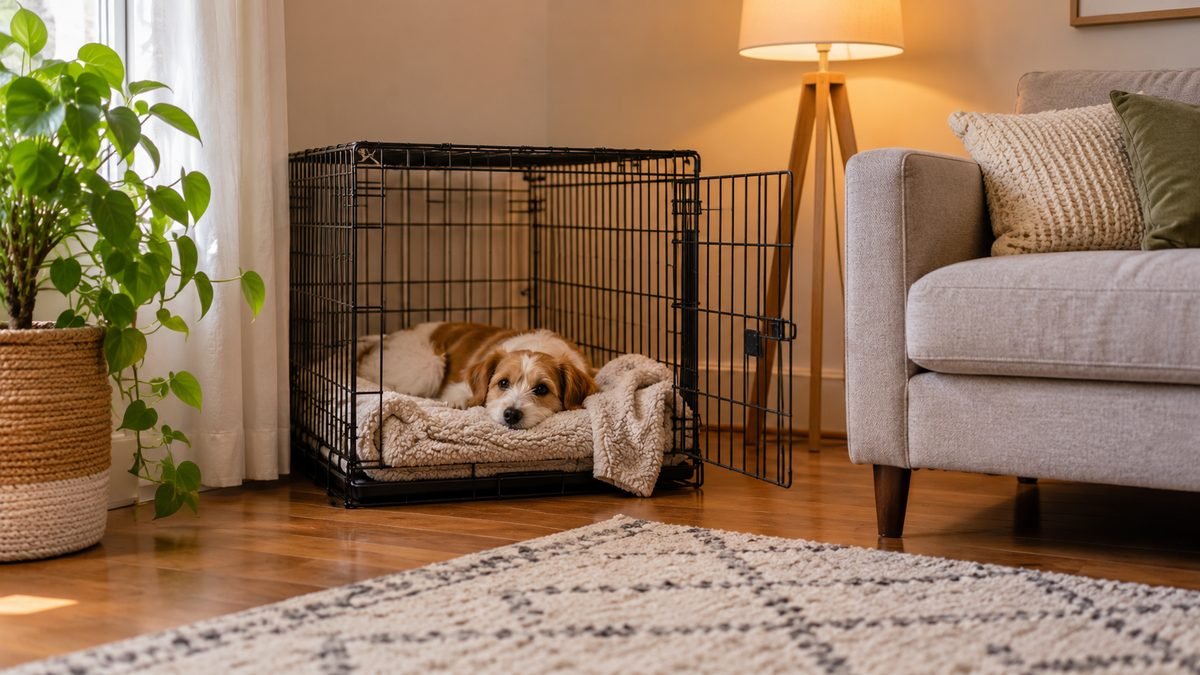
Short answer: put the crate in a quiet part of a room where your household spends time, such as a corner of the living room or beside your bed, and away from constant noise, foot traffic and strong light. Veterinary and animal-welfare sources agree on the principle: the crate should be near people but not in the middle of the commotion. In a small apartment that usually comes down to choosing between a quiet corner of the living space and a spot near your bed.
This guide covers placement, crate size, how long a dog can stay in a crate, and when a crate is not the right tool. Each point drawn from a source is cited. Practical tips for small apartments are labeled as our own editorial suggestions. We have not tested any crate, and this is general information, not veterinary or behavior advice.
The principle: near the family, but calm
Sources split the question into two parts.
- Where the family spends time. Humane World for Animals says that initially the crate should go where the family spends a lot of time, such as a family room. VCA suggests a room used often, such as a kitchen, den or bedroom, because dogs are social animals. UC Davis’s Clinical Animal Behavior Service says to place the crate in a common area.
- Quiet enough to rest. Humane World says the crate belongs in a calm part of the home where the dog can relax without constant stimulation or noise.
In a studio or one-bedroom, that points to a corner of the living area away from the front door and the kitchen traffic path, or a spot beside the bed.
Nighttime: keep it close
Humane World notes that it suggests keeping the crate in your bedroom or in a nearby hallway early on, especially for a puppy, and says older dogs should also initially be kept nearby. UC Davis did not specify a nighttime location. In a small apartment, a crate beside the bed can be the simplest option. It is also our suggestion to move it gradually if you later want it elsewhere. That is editorial, not sourced.
Small-apartment placement ideas (editorial)
These are our own suggestions, not published veterinary protocols:
- A living room corner, out of the main walkway.
- Beside your bed, for a puppy or a dog who settles better close to you.
- A hallway nook that is not the main route to the door.
- Under a desk, only if the crate is the correct size for the dog and the space does not cramp it.
- A furniture-style crate that doubles as a side table, if you want it to blend in.
Things to avoid (also editorial, we found no authoritative source specific to crate placement):
- Thin shared walls and doors where neighbors’ footsteps or hallway noise might trigger barking. For noise issues, see our guide to dog barking and noise complaints in apartments.
- A window with direct afternoon sun, radiators, baseboard heaters or heating and cooling vents.
- Slippery or uneven spots. A level surface is steadier.
Heat and light deserve a word of caution. Tufts’ Cummings School of Veterinary Medicine says not to crate dogs in a location with constant bright light, and advises avoiding high indoor temperatures by using fans and air conditioning. The AKC says staying indoors or in shade is the most important thing for keeping a dog cool, that dark coats absorb more heat from sunlight, and that dogs can struggle when indoor temperatures reach the high 80s. These are general heat guidance, not crate-specific rules.
Choosing the right size
Sources are consistent on size:
- Humane World: large enough for the dog to stand up and turn around in.
- AKC: for a puppy, choose a crate for the adult size and use a divider.
- VCA: stand, turn and stretch out.
- UC Davis: stand up and turn around freely.
For a growing puppy, UC Davis says to block off the back of the crate so there is no separate toilet area. In a small apartment, a divider lets you buy once and avoid storing outgrown crates.
Should you cover the crate?
VCA says some dogs feel more secure with a blanket draped over the crate, and the AKC says some dogs settle better in a darker, more den-like crate. We found no authoritative source on ventilation of covered crates, so our editorial suggestion is to leave part of the crate open for airflow and watch how your dog responds.
How long can a dog stay in the crate?
Time limits differ by source, so treat these as guidance and ask your vet about your dog:
- Humane World: puppies under 6 months should not be crated more than three or four hours at a time, and adult dogs not more than four to five hours during the day. Its FAQ also gives a puppy rule of age in months plus one hour. These statements are not perfectly consistent for very young puppies, so we cite them as written.
- VCA: never leave a puppy longer than it can control its bladder and bowels, giving daytime figures of up to about 3 hours at 2 months, 4 at 3 months and 5 at 4 months, and noting that individual puppies vary.
- AKC: no hour figure, but it warns against long stretches without bathroom breaks or exercise, and names pacing as a sign of anxiety, with whining mentioned in its FAQ.
If you work away from home, a crate used for long stretches may not suit your dog. For boredom and destructive behavior, see our guide on dog boredom and destructive chewing in a small apartment.
The crate is never punishment
Humane World, VCA and UC Davis all say crates should never be used for punishment.
When a crate may not be right
Humane World says a crate won’t solve separation anxiety, which is addressed with counterconditioning and desensitization, and recommends consulting a behavior professional. The AKC likewise says a crate is not a cure by itself for anxiety. The ASPCA says a crate helps some dogs if it is their safe place, but for others it can cause added stress, and suggests one room behind a baby gate as an alternative. VCA says continued anxiety, destruction or vocalization in the crate may indicate separation anxiety.
Quick checklist
- Choose a quiet spot in a room where you spend time.
- Keep it away from strong sun, heat sources and noisy doorways.
- Size it so the dog can stand, turn and lie down comfortably, and use a divider for a puppy.
- Put a rug or mat under it on hardwood to reduce scraping and noise (editorial).
- Keep crate time within sensible limits and watch for stress signs.
- Never use the crate as punishment.
- Check your lease for any rules about marks on walls and floors (see our guide to getting your security deposit back with a pet).
Frequently asked questions
Should the crate be in the bedroom or the living room?
Sources support either, as long as it is in a spot where the family spends time and the dog can rest. Humane World says early on, near your bedroom or in a nearby hallway can help with nighttime.
Is it okay to put a crate in a closet?
We found no source recommending this. Sources emphasize putting the crate where the family spends time.
What size crate do I need?
Large enough to stand, turn around and lie down comfortably. For a puppy, buy an adult-size crate with a divider.
Can I cover the crate?
Some dogs feel more secure with a blanket draped over the crate (VCA). Leave some airflow and watch your dog’s comfort.
How do I protect hardwood floors from the crate?
A rug or mat is our editorial suggestion. See our guide on protecting rental floors from pet scratches for more.
Sources
- Humane World for Animals, Crate Training 101
- AKC, How to Crate Train Your Dog in Nine Easy Steps (updated September 21, 2026)
- VCA Animal Hospitals, How to Crate Train Your Dog (July 22, 2019)
- UC Davis Clinical Animal Behavior Service, Crate Training Your Puppy
- ASPCA, Separation Anxiety
- Tufts Cummings School of Veterinary Medicine, Keeping Pets Cool in the Summer (June 22, 2023)
- AKC, How to Keep Your Dog Cool in Extreme Heat Without Air Conditioning (updated June 30, 2026)
This article is general information and is not veterinary or behavior advice. We have not tested any crate. Talk to your veterinarian or a qualified trainer about your dog.