
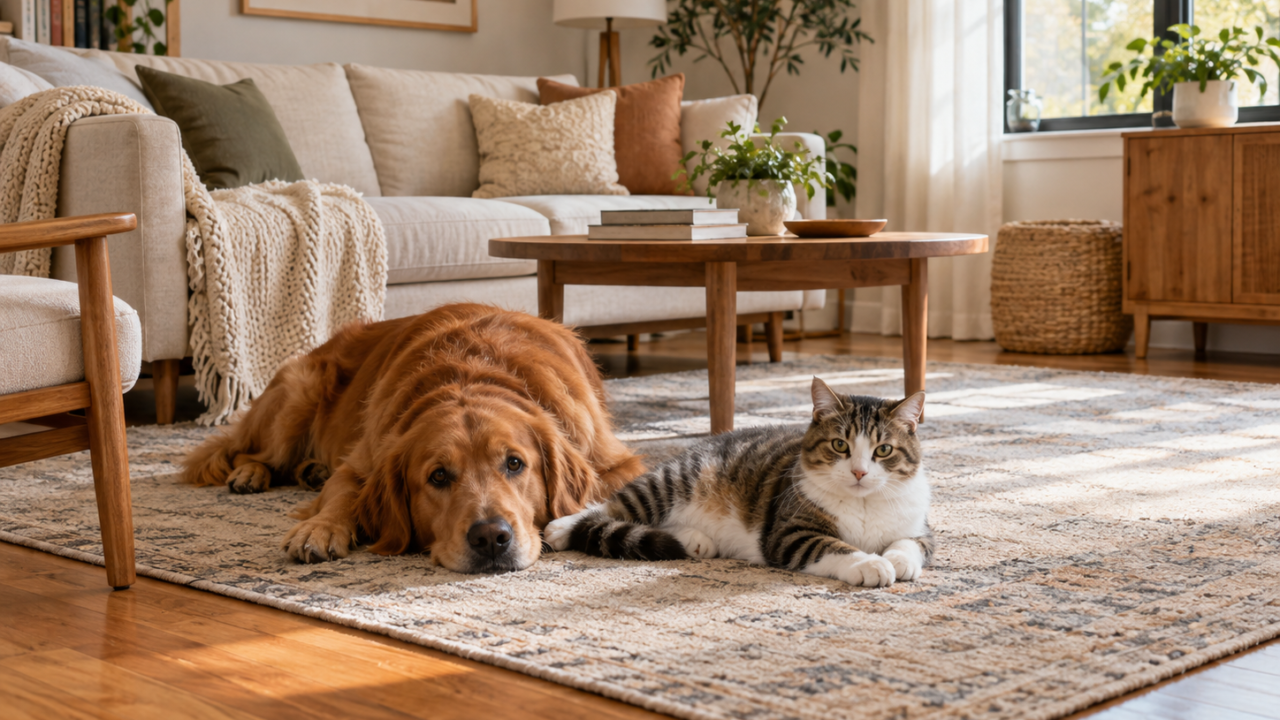
You don’t own the floor under your feet, but your dog or cat lives on it every day. That is where renting with a pet gets a little complicated. You want your home to feel like home, but you also don’t want to spend your last week before moving out wondering what is hiding underneath the rug.
The good news is that you don’t need to cover every inch of the floor. A better approach is to look at where your pet actually spends time, protect the places that take the most traffic, and choose products that make sense for the particular floor you have.
One important caveat: whether a floor mark counts as ordinary wear or damage depends on your lease and the laws that apply where you live. Nothing here guarantees a particular security-deposit outcome.
Start With the Places That Get Used the Most
Pet-related wear is rarely spread evenly across an apartment. Think about the route your dog takes from the front door to the sofa, the spot where your cat launches onto a favorite chair, or the area beside the food and water bowls. Those small, repetitive movements are much more useful to think about than the idea of somehow making the entire floor pet-proof.
Once you identify the busy spots, protection becomes much simpler. A washable runner may make sense in a hallway. A smaller mat may be enough near the door. If a rug keeps sliding, the problem may be the pad underneath rather than the rug itself.
Hardwood and Laminate Are Not the Same
If you rent, it is worth knowing what kind of floor you actually have. Hardwood and laminate have different repair and maintenance characteristics, and the care instructions for your particular floor matter more than a generic rule found online.
For example, a flooring retailer’s guidance notes that laminate generally cannot be sanded and refinished in the same way as real wood flooring, while hardwood can be refinished in appropriate circumstances. That does not mean every scratch on laminate requires a new plank, or that every hardwood floor can simply be sanded. The condition, construction and manufacturer’s instructions all matter.
If you can find out the flooring brand or product used in your rental, keep its care guide. It is a much better reference when you are deciding whether a particular mat, pad or cleaning product is appropriate.
Rugs and Runners: Often the Simplest First Step
For a busy hallway or the path between the door and the living room, a washable rug or runner can be a practical way to put another layer between paws and the floor. For pet owners, washable matters because a rug that looks great on day one is less useful if it becomes difficult to clean after a few muddy walks or shedding seasons.
The other half of the equation is stability. A rug that moves every time your dog runs across it can become a nuisance and may create its own problems. Look for a pad that is specifically compatible with your floor rather than assuming every non-slip product works everywhere.
Tumble, for example, describes its pet-friendly rugs as machine washable and as including a cushioned non-slip pad. Those are manufacturer claims, so check the current product page and the care instructions for the exact rug you are considering before buying.
Rug Pads: Check the Fine Print
A separate rug pad can be useful if you already have a rug you like. The important part is not simply whether the package says ‘non-slip.’ It is whether the manufacturer says the pad is suitable for your particular floor.
Gorilla Grip, for example, publishes a specific list of surfaces its rug gripper is not intended for, including carpet, vinyl, lacquered, acrylic, natural stone, porous and refinished surfaces. That kind of restriction is exactly the information a renter should check before putting a product down.
In other words, don’t shop only by the picture of the living room on the product page. Shop by the floor you actually have.
Clear Floor Protectors Can Work in Smaller Areas
If the problem is concentrated in one small spot, you may not need a full-size rug. Clear vinyl floor protectors can be useful around a doorway, under a feeding area, or in another place where a pet repeatedly stands or turns.
ExactMats, for example, offers different finishes for different hard-floor appearances. Its product information distinguishes between a Crystal finish intended for non-glossy and wood-grain flooring and a Riverstone option marketed for hard flooring including glossy and polished surfaces.
That distinction is a reminder that ‘clear’ does not automatically mean ‘compatible.’ Match the product to the finish of your floor and follow the manufacturer’s instructions.
What About Your Pet’s Nails?
Nail care can be part of the conversation, but it should not be treated as a magic fix for floor scratches. Cats and dogs scratch, run, turn and play for many different reasons, and nail care is only one part of the picture.
For cats in particular, the ASPCA recommends providing appropriate scratching surfaces and notes that regular nail trimming can help keep the tips relatively blunt. Scratching posts should be sturdy and appropriate for the cat’s preferred scratching style.
Nail caps are another product category, but suitability varies between animals. If you are considering caps, grinding or a new trimming routine specifically because you are worried about your floors, ask your veterinarian or a qualified groomer about the appropriate approach for your pet.
Furniture Legs Matter Too
Not every floor mark comes from paws. Dining chairs, sofas, tables and storage pieces can scratch flooring when they are dragged. Felt or silicone furniture-leg pads are inexpensive and easy to add, especially to pieces that get moved frequently.
This is one of those small fixes that is easy to overlook because it has nothing to do with the pet itself. But if you’re trying to keep a rental floor in good shape, it makes sense to protect both sides of the equation.
Things I Would Avoid in a Rental
Be cautious with permanent-looking solutions marketed for homeowners. Peel-and-stick flooring, strong permanent adhesives and other installations designed to stay in place may not be appropriate for a rental simply because they are inexpensive or easy to install.
The same principle applies to anything that touches the floor directly: no-drill or ‘renter-friendly’ marketing does not automatically mean residue-free removal. Read the manufacturer’s installation and removal instructions and, where appropriate, test a small inconspicuous area first.
A Simple Setup for a Small Apartment
You probably do not need a complicated system. Start with the busiest route in your home and build from there.
- High-traffic hallway: a washable rug or runner with a floor-compatible pad.
- Doorway: a smaller washable mat or compatible floor protector.
- Sliding rug: a separate pad chosen for the exact floor finish.
- Pet nail concerns: discuss trimming, grinding or other options with your veterinarian or groomer.
- Furniture that moves: add felt or silicone pads to the legs.
- Existing scratches: photograph them and check the flooring manufacturer’s care and repair guidance before trying a DIY fix.
Document the Floor Before Your Pet Has a Chance to Change It
If you’re renting, take photos when you move in. Photograph each room in good light and include existing marks, scuffs or worn areas. Keep the photos with your move-in paperwork rather than relying on a phone gallery months later.
When you move out, take comparable photos again. This does not guarantee a deposit refund, but it creates a record of the condition you started with and the condition you left behind.
Before You Buy Anything
- Identify the flooring material and, if possible, the manufacturer.
- Measure the area you actually need to protect.
- Check the product’s floor-compatibility instructions.
- Check whether the product has specific removal instructions.
- Look for washable or easy-care materials if the product will be exposed to pets regularly.
- Do not assume that a product described as ‘renter-friendly’ is guaranteed to leave no marks.
FAQ
Will a rug completely prevent scratches?
No. A rug can reduce direct contact in the area it covers, but it cannot protect uncovered flooring or prevent every kind of wear.
Can I use any rug pad on hardwood or laminate?
No. Pad materials and floor finishes vary. Check the manufacturer’s compatibility information for both the pad and your floor.
Are nail caps appropriate for every pet?
No. Suitability varies by animal. Product descriptions are not a substitute for veterinary or professional-grooming guidance.
Will protecting my floor guarantee my security deposit?
No. Deposit decisions depend on the lease, the property’s condition and the law that applies to the rental.
Should I repair scratches myself before moving out?
Not automatically. First check the flooring manufacturer’s care guidance and your lease. A repair attempt that is incompatible with the floor could make the situation worse.
Scratching furniture, not just floors? See how to stop cats scratching furniture in a rental.
A Note From PawSpace Living
We researched this guide around a simple renter’s question: what can you do before a small problem becomes an expensive one? We have not personally tested the products mentioned here. Product specifications and manufacturer claims should always be checked on the current product page before purchasing.
This article is for general informational purposes only and is not legal or veterinary advice. Check your lease and the applicable landlord-tenant rules for deposit questions, and speak with your veterinarian or a qualified groomer about pet nail care.