
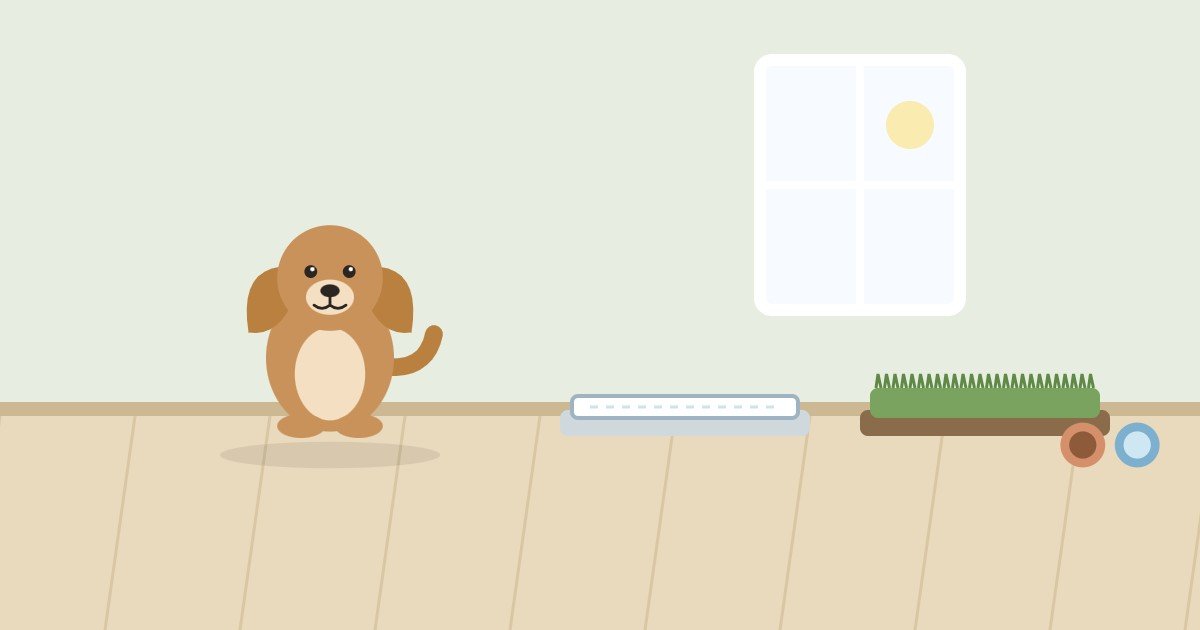
Short answer: an indoor dog potty spot makes sense for very young puppies, small or senior dogs, dogs with mobility problems, and homes where getting outside quickly is hard. The three common setups are disposable or washable pads, artificial or real grass in a tray, and litter-style boxes. Pads are the simplest to start with, grass trays feel closer to the outdoors, and the AKC calls a litter-style box the cleanest indoor setup. Whichever you choose, pick one spot, keep it consistent, and treat sudden accidents in a trained dog as a reason to call your veterinarian.
If you live on the fourteenth floor, work long shifts or share an elevator with half the building, an indoor option can take real pressure off both of you. It is also a tool with trade-offs, and the sources below are clear that it works best when you plan for it. This guide compares the options and explains how to set one up in a small space. For accident cleanup, we point you to our enzymatic cleaner guide instead of repeating it.
When an Indoor Option Makes Sense
The AKC lists very young puppies, and apartment dwellers as people who may benefit from pads. It also notes that pads can help while a puppy is not yet fully vaccinated and outdoor areas are heavily used by other dogs. (AKC: Potty Pad Training) A second AKC article adds apartment living without a yard, owners with mobility limits and frequent outdoor trips that are hard for young puppies. (AKC: Indoor Potty Training for Puppies)
- Young puppies: the AKC says many puppies cannot reliably control their bladders until about 16 weeks, and that toy breeds often need more frequent breaks.
- Senior dogs: the AKC says stairs, arthritis and reduced bladder control can make trips outside difficult, and that a nearby indoor spot can prevent accidents. (AKC: Senior Dogs and Indoor Potty Training)
- Long hours away: the Humane Society of the United States (now Humane World for Animals) suggests that if you are away more than four or five hours a day, you may need a pet sitter, a neighbor, or an indoor option such as pads, newspaper or a sod box. It adds that indoor training may lengthen outdoor training. (Humane World: How to Potty Train)
- Bad weather or a high-rise: an indoor spot can serve as a backup. Elevator waits, storms and heat waves are common sense reasons to want one, but those specific situations are our observation, not a source finding.
- Medical limits: if your vet has restricted your dog’s walking or your dog is recovering, an indoor spot may be useful. Ask your vet; we have no source for specific conditions.
Pads vs. Grass vs. Litter: Side by Side
The sources describe the setups but give no head-to-head ratings, so the cost and odor columns below are general, not measured. We have not tested any of these.
| Option | What it is | Mess and odor | Upkeep | Best for |
|---|---|---|---|---|
| Pads or newspaper | Disposable or washable absorbent sheets on the floor | Urine can leak past the edges or onto the floor, and a soiled pad holds odor until it is swapped | Ongoing purchase of disposables, or laundry for washable ones | Young puppies, quick start, small budgets |
| Artificial or real grass in a tray | Turf or a sod patch in a shallow tray | Contained by the tray, but turf and trays need regular washing; real sod needs replacing | Rinse and wash turf; replace sod; tray and turf cost more upfront | Dogs that already like grass, senior dogs |
| Litter-style box | A low-sided box or large cat box with a liner such as pads, turf or litter | The AKC calls it the cleanest option, since the sides hold the mess in | Refill or swap the liner; box takes floor space | Small dogs and puppies, tight rooms |
Pads
Pads are the simplest setup to start with, in our observation; the sources we read do not compare costs. For the cons, the AKC describes moving the pad gradually toward the door and then outside, so pads are best seen as a supporting tool, with an extra step later to move outdoors. Our own observation: a pad has no sides, so an energetic dog can miss the edge, and you will want an easy-to-clean floor underneath. The AKC makes the same point about the floor. (AKC: The Art of Paper-Training)
Artificial or Real Grass
The AKC notes that puppies develop surface preferences, and says to try another surface if a dog dislikes one. For a dog used to grass, a turf tray or sod box may fit that idea (our observation). The AKC also describes commercial artificial grass setups. Pros: it looks and feels closer to outdoors. Cons: turf has to be washed, and a tray takes up floor space. How often depends on your dog and the product, so follow the manufacturer’s care directions.
Litter-Style Boxes
The AKC calls a litter box the cleanest indoor setup and suggests a low-sided box so the puppy can step in, with a small cut-out entry for tiny puppies. Liners can be newspaper, pads, artificial grass or cat litter, chosen to be safe if the dog chews or eats it and easy to dispose of or wash. If the dog dislikes a surface, the AKC says to try another. (AKC) If you also share your home with a cat, keep the dog’s setup separate from the cat’s box; see our litter box guide for cat-side layouts. That separation is our suggestion.
Placement in a Small Apartment
The AKC advises a quiet, low-traffic spot with some privacy that you are happy to keep long term, on an easy-to-clean floor such as tile or linoleum. It says that if the box must move, shift it only a few inches a day. (AKC) For pads, the AKC says to choose one location and not move it during training. For senior dogs, it recommends a spot that is easy to reach.
In a studio, the bathroom, a corner of the entryway or a laundry nook often fits those criteria. That is our suggestion, since every layout differs. Keep it away from the dog’s bed and food bowls; that last part is common sense, not a sourced rule. If your landlord is strict about floors, put a waterproof mat or tray under the setup. Our guide to preventing pet damage in a rental covers more on protecting surfaces.
How to Teach It Without Confusing Your Dog
- Pick one spot and one surface. The AKC says to choose one area and avoid changing it until the puppy knows where to go.
- Take your dog there at predictable times. The AKC recommends visits after waking, eating, playing and napping, and at least every one to two hours otherwise for puppies. Feeding on a schedule makes timing more predictable.
- Watch for signals. The AKC lists sniffing, circling and whining as signs your puppy needs to go.
- Reward right away. Reward success. The AKC recommends rewarding the puppy for using the spot, and describes using a cue such as go potty.
- Use scent. The AKC suggests placing a paper towel with a little of your dog’s urine in the spot, which may help for senior dogs.
- Limit freedom until it is reliable. The AKC says to apply the same routines as outdoor training, including supervision. A crate or gated area sized to your dog helps; the AKC warns that an oversized crate lets a puppy use one end as a toilet.
On the confusion question, the sources agree on a few points: moving the pad confuses puppies, indoor training adds a step before outdoor training, and the AKC says to move the pad gradually toward the door, then outside, and to shrink the pad over time. If your goal is eventually outdoors only, decide that early and plan the transition. If you want a permanent indoor spot, decide that early too, so you are not changing it later (our suggestion).
Indoor training is not a substitute for activity. The AKC says it does not replace walks, socialization, exercise or mental stimulation. A bored dog is more likely to chew and bark, so see our guides on boredom and destructive chewing and barking and noise complaints.
Cleaning Accidents and Odor
VCA recommends cleaning up quietly without drawing attention to the accident, and using an enzyme-based cleaner to break down the odor. (VCA: House Soiling) Humane World says never to punish, scold or rub a puppy’s nose in it. Instead, calmly move the puppy to the right spot and reward success there.
VCA adds that scolding or punishing a dog for an accident tends to cause confusion and fear. For product types and what to look for, read our enzymatic cleaner guide. If you rent, urine on flooring is a deposit risk, so see how to remove pet odor before moving out.
When to Call the Vet
VCA advises asking a veterinarian to check for physical illness, particularly if the house soiling has started suddenly. Medical causes it lists include increased drinking and urination from kidney or liver disease, infection or diabetes, pain during elimination, and age-related cognitive decline. It adds that your veterinarian may recommend a veterinary behaviorist.
Cornell’s Riney Canine Health Center lists signs of a urinary tract infection that include straining to pee, frequent small urinations, accidents in the house, foul-smelling urine and blood in the urine, and notes that a suspected infection should be confirmed with a urinalysis. If you see these signs, contact your veterinarian. (Cornell: Urinary Tract Infections) Do not assume an indoor setup is the fix for a sudden change; have your dog checked first.
Pros and Cons of Going Indoor
- Pro: it helps when outdoor trips are hard because of age, mobility, vaccination timing or building layout.
- Pro: it gives a backup for bad weather.
- Con: it uses floor space in a small home and needs regular cleaning.
- Con: according to Humane World, indoor training may lengthen outdoor training.
- Con: ongoing cost for pads, liners or replacement turf, though amounts vary by product and we do not quote prices.
Frequently Asked Questions
Can I use pads and still teach my dog to go outside?
Yes. The AKC describes moving the pad gradually toward the door, then outside, and shrinking it over time. Humane World cautions that indoor training may lengthen outdoor training.
Is a litter box really okay for a dog?
The AKC describes a low-sided box with a safe liner as a workable, clean setup for puppies and small dogs. Choose a liner that is safe if your dog chews or eats it.
My trained dog is suddenly having accidents. Is it a training problem?
Not necessarily. VCA advises a veterinary check for physical illness, especially when house soiling starts suddenly. Call your vet before retraining.
What should I clean accidents with?
VCA recommends an enzymatic cleaner. See our cleaner guide for details.
Sources & Further Reading
- AKC: Housetraining Dogs: Puppy Potty Pad and Paper Training
- AKC: How to Potty Train a Puppy on Pads: Indoor House Training for Puppies
- AKC: The Art of Paper-Training
- AKC: Could Your Senior Dog Benefit From Indoor Potty Training?
- VCA Animal Hospitals: Dog Behavior Problems – House Soiling
- Humane World for Animals: How to Potty Train a Puppy
- Cornell Riney Canine Health Center: Urinary Tract Infections
This article is general information and is not veterinary or legal advice. We have not tested any product mentioned here; check current details on the product page before you buy.