
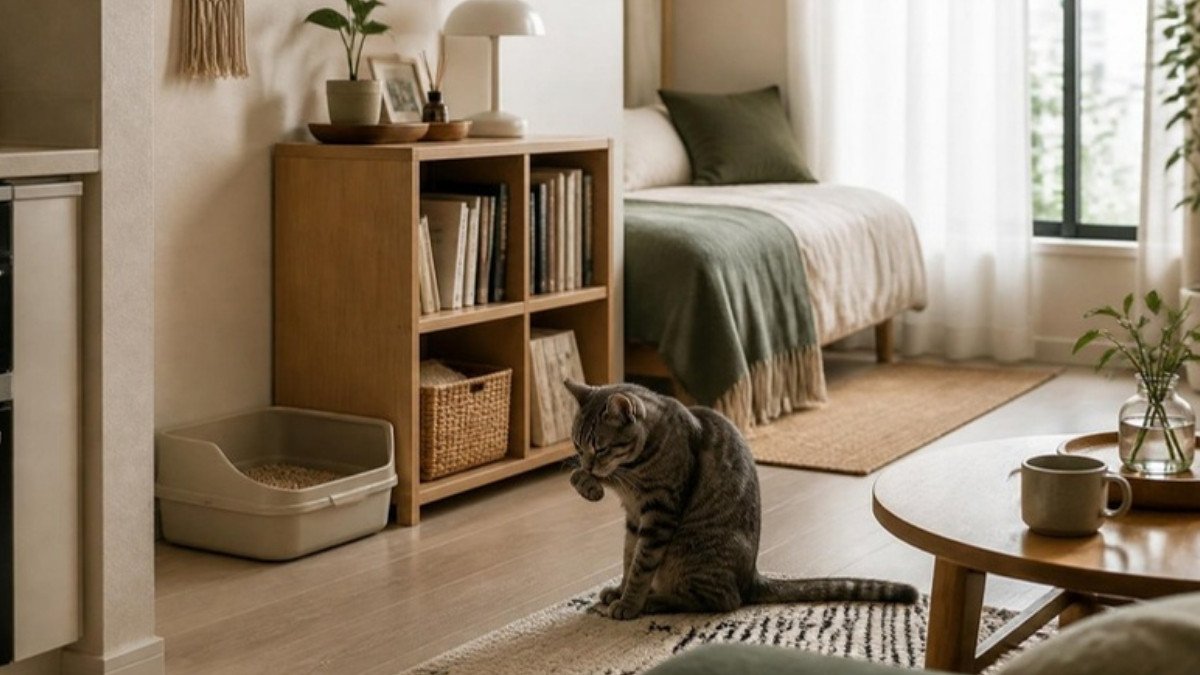
If you live in a studio or a one-bedroom and you’re down to one litter box wedged into whatever corner had room, you’re not alone — and you’re also probably fighting a losing battle against smell, tracking, and a cat who’s started using the bath mat instead. The advice that shows up everywhere — “one box per cat, plus one” — sounds simple until you’re standing in 500 square feet trying to figure out where two or three boxes are supposed to go without turning your apartment into a litter warehouse.
This isn’t a products roundup. It’s the actual guidance from veterinary and animal-behavior organizations on how many boxes cats need and where they need them, translated for people who don’t have a mudroom, a basement, or a spare bathroom to hide them in. If you are deciding which boxes to buy, our guide to the best litter box for a small apartment covers size, type and material.
The One-Per-Cat-Plus-One Recommendation
The number comes from ASPCA, and it’s echoed by the American Animal Hospital Association’s feline life-stage guidelines and by Humane World for Animals (formerly the Humane Society of the United States): one litter box for every cat in the household, plus one extra. One cat, two boxes. Two cats, three boxes. The ASPCA is direct about the consequence of skipping this: “Make sure you have one for each cat in your household, plus one extra,” and notes that not having enough boxes is one of the concrete, fixable reasons cats stop using them.
This isn’t arbitrary. Cats are territorial about where they eliminate, and in multi-cat homes a single shared box can become a source of competition — one cat guards it, another avoids it, and you end up finding “accidents” outside the box that have nothing to do with the box being dirty. The AAHA/AAFP feline life-stage guidelines frame it as one box per cat or per social group, plus one — so two cats who groom each other and sleep in a pile might functionally share, while two cats who avoid each other need fully separate setups.
The reason this matters more, not less, in a small apartment: multi-cat households have been getting more common, not less, and a lot of that growth is happening in apartments and condos rather than houses with yards. If you added a second cat to a one-bedroom and never added a second box, the setup you’re living with is exactly the scenario these guidelines are describing.
“But I Don’t Have Room for Three Litter Boxes”
You have more room than it feels like — you just don’t have a spare room. A few things worth knowing before you write off the extra box as impossible:
- The boxes don’t need to be identical, and they don’t need to be side by side. The point of “one per cat plus one” is giving cats real choice and reducing competition, not lining up matching boxes in a row. A box in a bathroom, one in a bedroom closet, and one behind a piece of furniture in the main room satisfies the guidance far better than three boxes stacked together in one spot — which functions more like one big box than three separate ones.
- Size still matters more than footprint. The AAHA guidelines recommend a box that’s roughly one and a half times the cat’s length from nose to tail, and specifically note that most commercial litter boxes fall short of that. In a small apartment, the instinct is to buy the smallest box that fits the space — but a too-small box is a documented reason cats stop using it, so it’s worth shrinking the number of decor compromises you’re willing to make before shrinking the box itself.
- Covered boxes save visual space but can cost you compliance. Both the AAHA guidelines and Humane World for Animals point out that covered boxes trap odor inside (which then hits you in a concentrated blast every time you lift the lid) and can make some cats hesitant because they can’t see what’s approaching. If you’re using a cover specifically to hide the box visually, an open box tucked into a cabinet, closet, or piece of furniture built for the purpose does the same visual job without the odor and visibility tradeoffs.
Where to Actually Put Multiple Boxes in a Small Layout
Every organization we checked gives some version of the same three placement rules, and they translate directly into apartment-specific spots:
- Quiet, but not cornered. ASPCA specifically warns against jamming a box into a tight corner with no escape route — cats want to see what’s approaching and have more than one way out. In practice, that rules out the very back of a closet behind a closed door, but it doesn’t rule out a closet with the door propped open, a bathroom, or an open nook.
- Away from food and water. This one is non-negotiable across every source and it’s an easy mistake in a studio, where the kitchen, the cat’s food station, and the only available floor space are often the same six square feet. Put real distance — a room’s width, ideally — between where your cat eats and where it eliminates.
- Not stacked with an appliance. Humane World for Animals specifically flags the noise from washers, dryers, and furnaces as a reason cats avoid a box — which matters if your only “extra” space is a laundry closet.
Realistic small-apartment spots that satisfy all three: a bathroom (as long as it’s not the only bathroom guests use constantly), a bedroom closet with the door left ajar or removed, the space beside or behind a dresser or bookshelf, under a console table with a curtain or litter-box cabinet front, or a repurposed corner of an entryway. If you’re a renter and considering a wall-mounted shelf, curtain rod, or small cabinet insert to screen a box, see our guide on preventing pet damage in a rental first — some mounting hardware is easier to remove cleanly than others when you move out.
Multi-level apartments and split layouts. If you’re in a loft or a two-floor unit, Humane World for Animals recommends at least one box per level so a cat is never forced to choose between “hold it” and a long trip down a flight of stairs.
Size, Litter Depth, and the Mistakes That Actually Cause Accidents
Once the number and placement are right, three smaller details determine whether it actually gets used:
- Litter depth: Both ASPCA and Humane World for Animals put the target around one to two inches — enough for cats to dig and cover, not so much that it feels unstable underfoot. More litter is not automatically better.
- Scooping: Every source agrees on at least once a day. In a small apartment, a dirty box is not just a behavior risk — it’s the single biggest driver of the smell that reaches every room, since there’s no hallway or basement to contain it in.
- Full cleanings: ASPCA recommends washing every box weekly with warm water and unscented soap (no ammonia-based cleaners, which smell like cat urine to a cat’s nose). AAHA and Humane World for Animals describe similar full-changeout schedules — Humane World notes clumping litter is typically fully replaced every two to three weeks with daily scooping in between, while non-clumping litter needs a full change roughly twice a week.
If odor is already a problem in your unit — especially if you’re getting close to a move-out inspection — our guide on removing pet odor before moving out of a rental covers the deeper cleaning steps that go beyond the litter box itself.
When It’s Not About the Number or the Spot
If you’ve matched the “one per cat plus one” rule, fixed the placement, and a cat is still eliminating outside the box, every source we checked agrees on one thing: rule out a medical cause before assuming it’s behavioral. ASPCA notes that urinary tract infections, feline interstitial cystitis, kidney disease, and arthritis (which can make climbing into a high-sided box painful, especially for older cats) are all documented medical drivers of litter box avoidance — and that this is common enough that it’s the first thing to check with a vet, not the last.
Once your boxes are placed, see our guide on how to stop litter tracking in a small apartment.
FAQ
Can two cats really share one litter box if I only have room for two total?
It depends on the cats. AAHA’s guidance allows for one box per social group rather than strictly per cat — cats who are closely bonded may functionally share. Cats who avoid or compete with each other generally need their own. Watch behavior, not just headcount.
Is a smaller “apartment-sized” litter box actually a problem?
It can be. Undersized boxes are a documented reason cats stop using a box. If floor space is the real constraint, prioritize one appropriately sized box over two undersized ones, and add the second box somewhere else in the unit rather than shrinking both.
Does litter box furniture (cabinets, benches) count as “hiding” the box in a bad way?
Not inherently — the concern from AAHA and Humane World for Animals is about fully enclosed covers that trap odor and block visibility for the cat, not about furniture that screens the box from a human’s view while leaving it open and accessible on the inside.
How often should I actually be scooping if I only have one cat?
Daily, per ASPCA, AAHA, and Humane World for Animals — regardless of how many cats you have. A single cat’s box will get dirty enough to trigger avoidance in the same one to two days that a multi-cat box would.
A Note From PawSpace Living
We didn’t test specific litter boxes, cabinets, or litter brands for this article, and we’re not naming products here — this is the underlying guidance from ASPCA, AAHA/AAFP, and Humane World for Animals, applied to small-apartment layouts. Local laws, lease terms, and individual cats vary, so use this as a starting framework, not a substitute for your vet’s advice about a specific cat.
Sources & Further Reading
- ASPCA — Litter Box Problems
- AAHA/AAFP — 2021 Feline Life Stage Guidelines, General Litter Box Considerations
- Humane World for Animals — How to Litter Train a Kitten or Cat
- San Diego Humane Society — Litter Box 101