
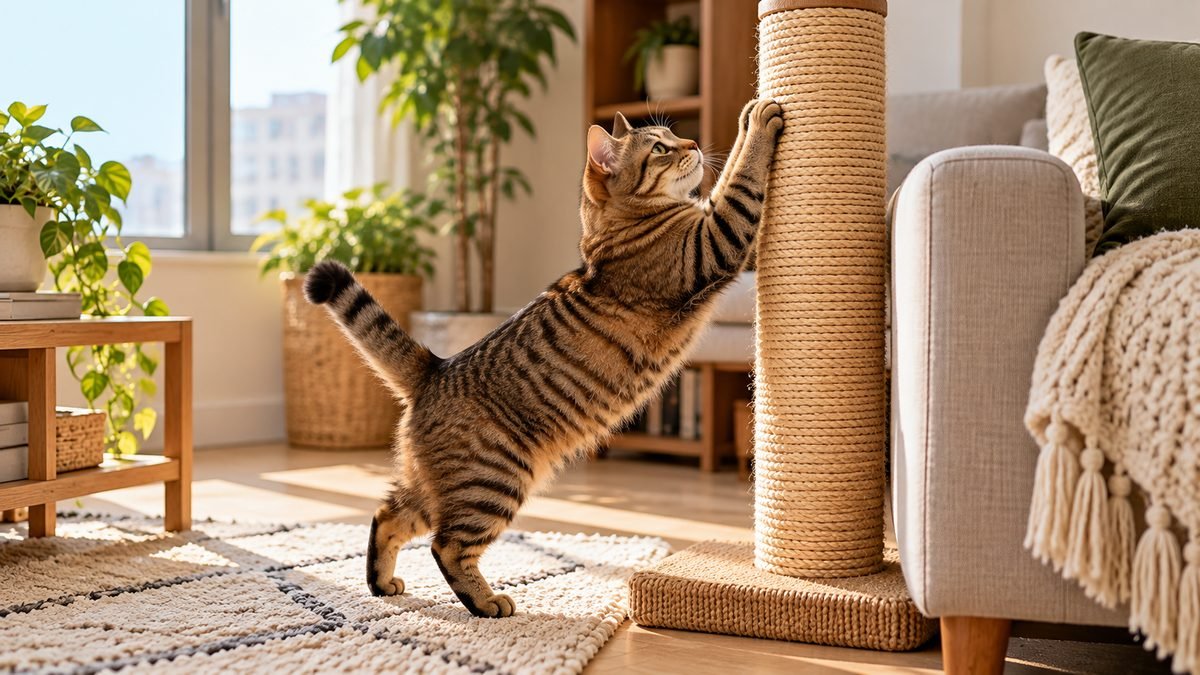
Short answer: you can’t stop a cat from scratching, because scratching is normal, instinctive behavior. What you can do is give the cat something better to scratch, put it in the right place, and protect the furniture you most want to save. Veterinary and animal-welfare sources agree on that approach: teach the cat where to scratch rather than trying to eliminate scratching.
If you rent, the stakes are a little higher. Damaged upholstery on your own couch is annoying; damaged trim, doors or carpet can show up at move-out. This guide walks through why cats scratch, a four-step fix, nail care, and why declawing is not the answer. Evidence-based points are cited. Practical tips that are our own editorial suggestions are labeled as such. We have not tested any scratcher, tape or nail cap, and this is general information, not veterinary or legal advice.
Affiliate disclosure: As an Amazon Associate I earn from qualifying purchases. Read our full Affiliate Disclosure.
Product pick
Catify Scratching Ramp
A compact sisal ramp listed at about 15 x 9 x 6.7 inches. It is not a guaranteed fix for furniture scratching; cats differ in the angles, heights and materials they prefer. We have not tested it.
View on AmazonWhy cats scratch
Scratching is not misbehavior. The ASPCA lists stretching, marking territory, play, and shedding the worn outer layers of the claws to expose sharper ones. Ohio State’s Indoor Pet Initiative adds that scratching stretches muscles and leaves a scent mark. Cornell Feline Health Center describes the behavior as largely scent marking, from glands in the paws, and removal of the outer claw sheaths, which is why it is hard to stop and better to redirect.
Two practical points follow from that:
- Indoor cats may scratch furniture, walls and doors, while outdoor cats typically use trees and fence posts (VCA).
- Cats often scratch right after waking, to stretch (ASPCA, AAFP). Ohio State suggests placing scratchers near sleeping areas for this reason.
The four-step fix
Step 1: Offer the right scratcher
Sources agree on the basics, and they are worth matching to what your cat already does:
- Offer more than one style and material. The ASPCA suggests flat, upright and angled options in materials such as cardboard, carpet, rope and wood. The AAFP’s toolkit notes that more scratchers in the home means more use, and suggests mixing vertical and horizontal.
- Match what the cat already scratches. Ohio State says to offer vertical posts for cats hitting chair legs and couch corners, and horizontal mats for cats scratching rugs. Sisal is recommended by Ohio State and the AAFP.
- Make it sturdy and tall. Posts should be steady and tall enough for a full stretch (ASPCA). Cornell says at least as tall as the cat stretched out. The AAFP’s survey-based ideal is a simple upright post of at least 3 feet, with two or three levels.
- Material preference varies. The AAFP reports sisal rope is most preferred for cats 9 and under, while cats 10 and older slightly prefer carpet. VCA notes cats often like loosely woven materials such as sisal or bare wood over tight weaves.
- Don’t throw away a worn favorite. Cornell and the ASPCA both say a worn post is a post that works.
In a small apartment, a tall, slim post or a flat cardboard scratcher that slides under a table can fit where a large cat tree can’t. That is our own suggestion, not a published protocol.
As an Amazon Associate I earn from qualifying purchases. See our affiliate disclosure. One compact option is the Catify scratching ramp, a sisal ramp listed at about 15 x 9 x 6.7 inches. It is not a guaranteed fix for furniture scratching. Cats differ in the scratching angles, heights and materials they prefer, so a ramp may suit some cats and be ignored by others. We have not tested it. If your cat skips it, try a different angle or material, such as a tall vertical post.
Step 2: Put it in the right place
Placement does most of the work. Sources suggest:
- Next to or in front of the furniture the cat already scratches, then moving it gradually. Ohio State says no more than 3 inches a day.
- Near where the cat naps, because cats scratch after waking (ASPCA). Ohio State adds room entrances, and in multi-cat homes, routes to food, water and litter.
- In front of a preferred target such as a couch leg or an exterior door, or near windows (AAFP).
- If a favorite chair is replaced, the AAFP warns that scratching may transfer to the new piece of furniture.
Step 3: Encourage and reward
Dangle a wand toy over the post or use catnip to get interest (ASPCA). Reward use with treats, praise or catnip (Cornell). The AAFP says to reward within about 3 seconds, and notes that catnip doesn’t work for kittens under 4 months or for some adult cats. Don’t hold the cat against the post (ASPCA).
Step 4: Protect the furniture you care about
Deterrents work best when a good alternative already exists (VCA). Sources list double-sided tape, foil, plastic, sandpaper, an upside-down plastic carpet runner with the nubby side up, and plastic furniture protectors on couch corners (ASPCA, Ohio State, AAFP, VCA). The AAFP cautions to keep plastic away from cats that chew it, and Ohio State cautions against harmful or strong odors.
Commercial scratchers that attach to couch arms can also divert scratching (AAFP).
Renter-specific tips (editorial, not sourced)
We found no authoritative source on lease rules, deposits or landlord policies around cat scratching, so these are practical suggestions only:
- Photograph furniture, trim and walls at move-in. Dated photos make move-out discussions easier. Our guide to getting your security deposit back with a pet explains how.
- Ask before using adhesive on walls or trim, and test tape on a hidden spot first.
- Prefer freestanding posts over wall-mounted ones so you aren’t drilling into a rental.
- Use slipcovers or couch-arm protectors on furniture you don’t own.
- Check the lease for pet-damage language. For a broader look at preventing wear in a rental, see our guide to preventing pet damage in a rental and our guide to protecting rental floors from pet scratches.
Whether a landlord can charge for damage depends on your lease and your state. This isn’t legal advice.
Nail care and soft caps
Regular trims reduce damage. The ASPCA suggests weekly trims, one or two nails per session, paired with a treat. Ohio State recommends cat-specific trimmers, since human clippers can crush the nail, avoiding the pink quick, and getting the cat used to paw handling with treats. Cornell also says to avoid the quick.
Soft caps are adhesive plastic covers for the claws. The ASPCA describes them as temporary, lasting four to six weeks, while Cornell says to replace them every six to twelve weeks and to use them only on cats that tolerate paw handling. Because sources differ, treat duration as a range. The AAFP cautions that some cats resent application and others remove caps quickly, and notes that caps can be applied at a clinic or learned at home.
Why declawing is not the answer
Declawing is not a nail trim. The ASPCA describes it as removing the last toe bone, with risks including anesthesia complications, bleeding, infection and chronic pain, and says it is not proven to fix behavior problems. The AVMA discourages elective declawing and supports non-surgical alternatives. The AAFP opposes elective declawing and ended it in its Cat Friendly Practices program effective January 1, 2021. Cornell calls it amputation of the bone tips and says it does not remove the urge to scratch, and describes it as a last resort only when the alternative is removing the cat from the home. A Humane Veterinary Medical Alliance poster from Humane World says it has no medical benefit for the cat.
If a landlord or lease asks you to declaw, that is a conversation to have with your veterinarian and, if needed, someone who can advise on your lease. We can’t give legal advice.
When scratching suddenly increases
A sudden change deserves attention. The AAFP says scratching and marking often rise with anxiety, stress, conflict with other cats or limited resources, and recommends a physical exam to check for pain if scratching increases. Common stressors it lists are other cats, household changes, schedule disruption and boredom. VCA lists a new cat, a move or a schedule change, and says scratching new areas may signal anxiety. Reducing boredom with play, perches and food puzzles may help, and see our guide on why cats yowl at night if stress shows up as nighttime noise.
Punishment doesn’t work
Cornell says cats don’t link punishment to scratching and may come to fear their owners or scratch only when you are away. The AAFP says punishment can increase anxiety, scratching and marking. VCA recommends against physical punishment. The ASPCA treats clapping or spraying water as a last resort because the cat may become afraid of you.
Quick checklist
- At least two scratchers, one vertical and one horizontal, in different spots.
- Placed beside the furniture being scratched and near the cat’s nap spot.
- Treats, catnip or a wand toy used to build the habit.
- Tape or protectors on the target furniture.
- Weekly nail trims, with treats.
- Move-in photos and a lease check.
Frequently asked questions
Will scratching posts stop my cat from scratching the couch?
Not on their own. Sources say a post helps when it is the right type and in the right place, and that deterrents work only if an appealing alternative exists.
Are soft caps safe for cats?
The sources describe them as an alternative to declawing, but note some cats resent application. Ask your veterinarian whether they suit your cat.
Is it normal for a cat to scratch right after waking?
Yes. The ASPCA and the AAFP both note that cats stretch and scratch after sleeping.
Are sprays and citrus deterrents recommended?
Ohio State cautions against harmful or strong odors, and a Humane World poster lists citrus spray as an option. Treat sprays as secondary to providing a good alternative.
Sources
- ASPCA, Scratching Behavior in Cats and Destructive Scratching
- ASPCA, Position Statement on Declawing Cats
- Ohio State University Indoor Pet Initiative, Scratching
- Cornell Feline Health Center, Feline Behavior Problems: Destructive Behavior (updated March 2018)
- AAFP, Claw Friendly Educational Toolkit: Scratching Resources
- AAFP, AAFP ends elective declawing in Cat Friendly Practices
- VCA Animal Hospitals, Cat Behavior Problems: Scratching Behavior (July 9, 2019)
- AVMA, Declawing of Domestic Cats
- Humane Veterinary Medical Alliance, Cat Declawing poster
This article is general information and is not veterinary or legal advice. We have not tested any scratcher, deterrent or nail cap. If your cat’s behavior changes suddenly, talk to your veterinarian.